褟 (tā) means "inner garment; undershirt" in Chinese. It has 15 strokes with the radical 衤.
Rated 4.2/5 in difficulty (advanced).
Appears in 3+ common words including 汗褟儿 (hàn tā ér), 白褟 (bái tā), 褟子 (tā zi).
Due to its 15 strokes, Hanzi Writer's error detection shows 褟 requires focused practice — most learners need 10+ attempts for consistent accuracy.
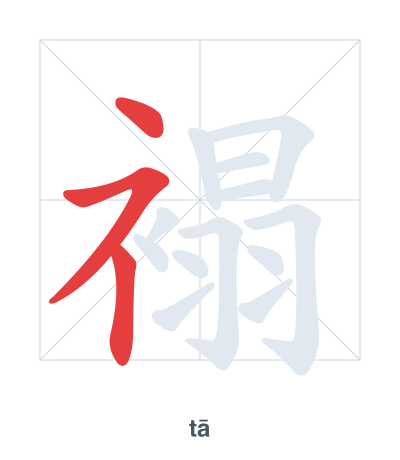
Open Hanzi Writer to see the animated stroke order and practice writing 褟 with real-time feedback.
The character 褟 (tā) is written with 15 strokes. Follow the standard Chinese stroke order: top to bottom, left to right, outside before inside. The radical 衤 is one of its key components.
Practice the correct stroke order with the Hanzi Writer app to see animated stroke-by-stroke guidance with real-time feedback.
褟 means inner garment; undershirt.
褟 is a phono-semantic compound: the left side 衤 (a variant of 衣, meaning 'clothing') indicates the character's connection to garments, while the right side 沓 (tà, meaning 'to repeat' or 'pile up') provides the pronunciation and hints at an undershirt worn as an inner layer.
💡 Memory Tip: Imagine a T-shirt (衤) with a tag that says 'T.A.' (沓) for the inner layer you wear under everything.
这件汗褟儿很凉快。
zhè jiàn hàn tā ér hěn liáng kuài
This undershirt is very cool.
他穿了一件白褟。
tā chuān le yī jiàn bái tā
He wore a white undershirt.
这件褟子洗干净了。
zhè jiàn tā zi xǐ gān jìng le
This undershirt has been washed clean.
Open Hanzi Writer to see the animated stroke order and practice writing 褟 with real-time feedback.
✨ Animated stroke order · Handwriting recognition · HSK-graded practice · Free to use
褟 is composed of the radical 衤 on the left, which means clothing, and a phonetic component on the right that resembles 㕣 (a combination of 羽 and 口). The radical directly connects the character to garments, while the right side provides pronunciation hints for tā. Together, the structure points to a type of clothing—specifically an inner garment or undershirt worn close to the body.