悚 (sǒng) means "terrified" in Chinese. It has 10 strokes with the radical 忄.
Rated 4.2/5 in difficulty (advanced).
Appears in 3+ common words including 惊悚 (jīng sǒng), 毛骨悚然 (máo gǔ sǒng rán), 悚惧 (sǒng jù).
Due to its 10 strokes, Hanzi Writer's error detection shows 悚 requires focused practice — most learners need 10+ attempts for consistent accuracy.
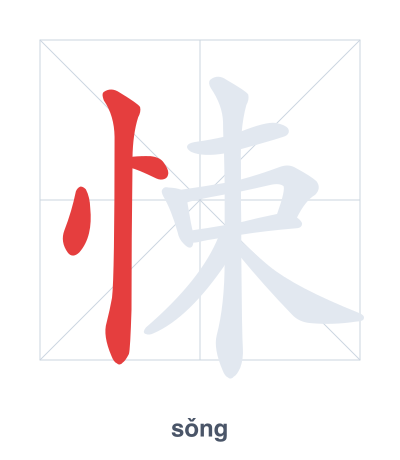
Open Hanzi Writer to see the animated stroke order and practice writing 悚 with real-time feedback.
The character 悚 (sǒng) is written with 10 strokes. Follow the standard Chinese stroke order: top to bottom, left to right, outside before inside. The radical 忄 is one of its key components.
Practice the correct stroke order with the Hanzi Writer app to see animated stroke-by-stroke guidance with real-time feedback.
悚 means terrified.
悚 combines the heart radical 忄 (xīn, heart/mind) with 束 (shù, to bind or tie), literally depicting a heart that is tied up or constricted. This visual metaphor represents the tight, choked sensation in the chest when one is terrified.
💡 Memory Tip: Imagine your heart (忄) is tied in a tight bundle (束) of fear, making you feel completely terrified.
我喜欢看惊悚片。
wǒ xǐ huān kàn jīng sǒng piàn
I like watching thrillers.
那个故事让人毛骨悚然。
nà ge gù shì ràng rén máo gǔ sǒng rán
That story is spine-chilling.
他感到十分悚惧。
tā gǎn dào shí fēn sǒng jù
He felt very terrified.
Open Hanzi Writer to see the animated stroke order and practice writing 悚 with real-time feedback.
✨ Animated stroke order · Handwriting recognition · HSK-graded practice · Free to use
The left side is the radical 忄 (heart), showing the character relates to emotions or feelings. The right side is 束 (shù), meaning 'to bind' or 'a bundle,' which suggests being tied up or constrained by fear. Together, they create the idea of a heart feeling bound or tightened—terror.