咝 (sī) means "hiss; sizzle (onomatopoeia)" in Chinese. It has 8 strokes with the radical 口.
Rated 3.7/5 in difficulty (challenging).
Appears in 3+ common words including 咝咝 (sī sī), 咝的一声 (sī de yī shēng), 抽咝 (chōu sī).
Due to its 8 strokes, Hanzi Writer's error detection shows 咝 requires focused practice — most learners need 10+ attempts for consistent accuracy.
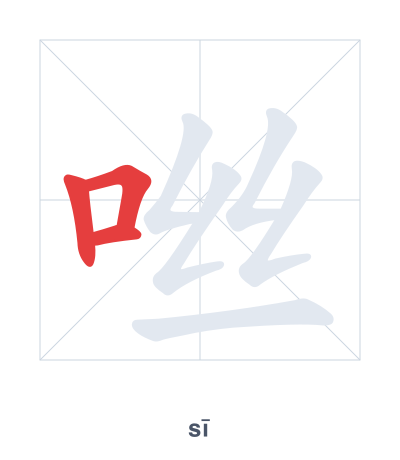
Open Hanzi Writer to see the animated stroke order and practice writing 咝 with real-time feedback.
The character 咝 (sī) is written with 8 strokes. Follow the standard Chinese stroke order: top to bottom, left to right, outside before inside. The radical 口 is one of its key components.
Practice the correct stroke order with the Hanzi Writer app to see animated stroke-by-stroke guidance with real-time feedback.
咝 means hiss; sizzle (onomatopoeia).
咝 is a compound character combining the mouth radical (口), representing sound, with 丝 (silk), which provides the pronunciation (sī). The hissing or sizzling sound it depicts evokes the soft, continuous noise of silk brushing against itself or a snake's hiss.
💡 Memory Tip: Imagine a mouth (口) making a 'sss' sound while spitting out thin silk threads (丝) that sizzle as they hit the ground.
蛇发出咝咝声。
shé fā chū sī sī shēng
The snake makes a hissing sound.
咝的一声,火灭了。
sī de yī shēng huǒ miè le
With a hiss, the fire went out.
他疼得直抽咝。
tā téng dé zhí chōu sī
He kept hissing in pain.
Open Hanzi Writer to see the animated stroke order and practice writing 咝 with real-time feedback.
✨ Animated stroke order · Handwriting recognition · HSK-graded practice · Free to use
咝 is a left-right character. The left part 口 (mouth) indicates it is a sound-related word, while the right part 丝 (silk, also pronounced sī) gives the pronunciation and suggests a thin, continuous sound like a silk thread. Together, they represent a hissing or sizzling noise.