筲 (shāo) means "bamboo basket (for rice)" in Chinese. It has 13 strokes with the radical 竹.
Rated 4.2/5 in difficulty (advanced).
Appears in 3+ common words including 筲箕 (shāo jī), 水筲 (shuǐ shāo), 斗筲 (dòu shāo).
Due to its 13 strokes, Hanzi Writer's error detection shows 筲 requires focused practice — most learners need 10+ attempts for consistent accuracy.
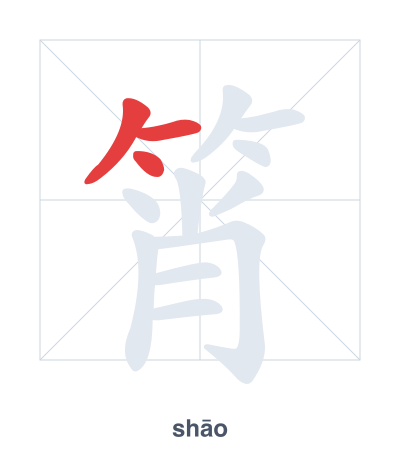
Open Hanzi Writer to see the animated stroke order and practice writing 筲 with real-time feedback.
The character 筲 (shāo) is written with 13 strokes. Follow the standard Chinese stroke order: top to bottom, left to right, outside before inside. The radical 竹 is one of its key components.
Practice the correct stroke order with the Hanzi Writer app to see animated stroke-by-stroke guidance with real-time feedback.
筲 means bamboo basket (for rice).
筲 is a phono-semantic compound: the radical 竹 (bamboo) indicates the material, while 肖 (shāo) provides the pronunciation and originally suggested a small or resembling shape. Together they form a small bamboo basket used for holding rice, as seen in ancient Chinese kitchens.
💡 Memory Tip: Imagine a bamboo (竹) basket that is so small it can only hold a single scoop of rice, and the shape resembles (肖) a tiny bowl.
他拿了一个筲箕。
tā ná le yí gè shāo jī
He took a bamboo sieve.
桶里有一个水筲。
tǒng lǐ yǒu yí gè shuǐ shāo
There is a water bucket inside the barrel.
这只是斗筲之器。
zhè zhǐ shì dǒu shāo zhī qì
This is just a person of narrow capacity.
Open Hanzi Writer to see the animated stroke order and practice writing 筲 with real-time feedback.
✨ Animated stroke order · Handwriting recognition · HSK-graded practice · Free to use
筲 is composed of the radical 竹 (bamboo) on top, indicating the object is made of bamboo, and the phonetic component 肖 (xiào) below, which hints at the pronunciation. Together, the character represents a bamboo basket, specifically one for holding rice.