箕 (jī) means "winnowing basket / dustpan" in Chinese. It has 14 strokes with the radical 竹.
Rated 4.2/5 in difficulty (advanced).
Appears in 3+ common words including 簸箕 (bò jī), 箕斗 (jī dǒu), 箕坐 (jī zuò).
Due to its 14 strokes, Hanzi Writer's error detection shows 箕 requires focused practice — most learners need 10+ attempts for consistent accuracy.
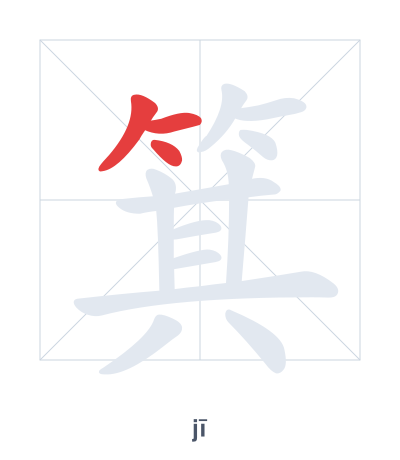
Open Hanzi Writer to see the animated stroke order and practice writing 箕 with real-time feedback.
The character 箕 (jī) is written with 14 strokes. Follow the standard Chinese stroke order: top to bottom, left to right, outside before inside. The radical 竹 is one of its key components.
Practice the correct stroke order with the Hanzi Writer app to see animated stroke-by-stroke guidance with real-time feedback.
箕 means winnowing basket / dustpan.
The character 箕 combines the radical ⺮ (bamboo) with 其, which originally depicted a winnowing basket made of woven materials. The bamboo radical indicates the material, while 其 provides the phonetic clue and echoes the object’s shape, together forming a word for a bamboo winnowing basket or dustpan.
💡 Memory Tip: Picture a bamboo (⺮) dustpan shaped like a square grid (其) used to sift grain or sweep dirt.
请把垃圾扫进簸箕。
qǐng bǎ lā jī sǎo jìn bò jī
Please sweep the trash into the dustpan.
每个人的指纹都有箕斗。
měi gè rén de zhǐ wén dōu yǒu jī dǒu
Everyone's fingerprints have loops and whorls.
他在草地上箕坐着。
tā zài cǎo dì shàng jī zuò zhe
He is sitting on the grass with his legs spread out.
Open Hanzi Writer to see the animated stroke order and practice writing 箕 with real-time feedback.
✨ Animated stroke order · Handwriting recognition · HSK-graded practice · Free to use
The character 箕 consists of the radical 竹 (bamboo) on top and 其 below. Since a winnowing basket or dustpan was traditionally made of bamboo, the 'bamboo' component directly shows the material, while 其 provides the sound (jī) and hints at the object's shape.