绱 (shàng) means "To sole a shoe; to attach a sole to an upper" in Chinese. It has 11 strokes with the radical 纟.
Rated 4.2/5 in difficulty (advanced).
Appears in 3+ common words including 绱鞋 (shàng xié), 绱底 (shàng dǐ), 绱帮 (shàng bāng).
Due to its 11 strokes, Hanzi Writer's error detection shows 绱 requires focused practice — most learners need 10+ attempts for consistent accuracy.
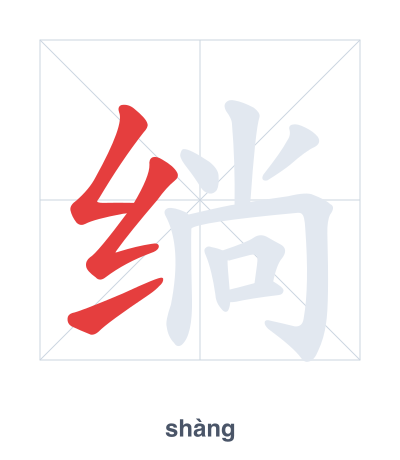
Open Hanzi Writer to see the animated stroke order and practice writing 绱 with real-time feedback.
The character 绱 (shàng) is written with 11 strokes. Follow the standard Chinese stroke order: top to bottom, left to right, outside before inside. The radical 纟 is one of its key components.
Practice the correct stroke order with the Hanzi Writer app to see animated stroke-by-stroke guidance with real-time feedback.
绱 means To sole a shoe; to attach a sole to an upper.
绱 is a phono-semantic compound. The left radical 纟 (silk thread) represents sewing or binding, while the right component 尚 (shàng) provides the pronunciation. Together, they depict using thread to attach the upper part of a shoe to its sole.
💡 Memory Tip: Imagine a thread (纟) sewing the 'upper' (尚 sounds like 'upper') of a shoe onto the sole, stitching them firmly together.
他正在学习绱鞋。
tā zhèng zài xué xí shàng xié
He is learning how to sole shoes.
绱底需要很用力。
shàng dǐ xū yào hěn yòng lì
Attaching the sole requires a lot of strength.
这双鞋还没绱好。
zhè shuāng xié hái méi shàng hǎo
The soles of these shoes haven't been attached yet.
Open Hanzi Writer to see the animated stroke order and practice writing 绱 with real-time feedback.
✨ Animated stroke order · Handwriting recognition · HSK-graded practice · Free to use
绱 is made of two parts: the left side is the radical 纟 (silk thread), and the right side is 尚 (shàng, meaning 'still' or 'yet'). The silk radical hints that the character relates to cloth or thread, and together with 尚, which provides the pronunciation shàng, it specifically refers to the action of stitching a shoe sole onto the upper using thread.