缮 (shàn) means "To repair; to transcribe; to copy" in Chinese. It has 15 strokes with the radical 纟.
Rated 4.2/5 in difficulty (advanced).
Appears in 3+ common words including 修缮 (xiū shàn), 缮写 (shàn xiě), 缮校 (shàn xiào).
Due to its 15 strokes, Hanzi Writer's error detection shows 缮 requires focused practice — most learners need 10+ attempts for consistent accuracy.
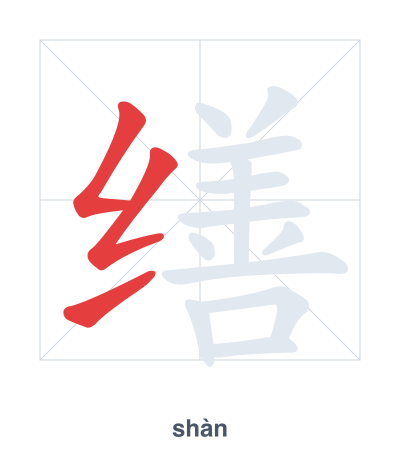
Open Hanzi Writer to see the animated stroke order and practice writing 缮 with real-time feedback.
The character 缮 (shàn) is written with 15 strokes. Follow the standard Chinese stroke order: top to bottom, left to right, outside before inside. The radical 纟 is one of its key components.
Practice the correct stroke order with the Hanzi Writer app to see animated stroke-by-stroke guidance with real-time feedback.
缮 means To repair; to transcribe; to copy.
Combines 纟 (silk thread) with 善 (good, virtuous). Silk thread suggests mending fabric, and 善 adds the notion of making something whole and good again, hence 'to repair.' The meaning extended to 'to transcribe' or 'to copy,' as in carefully restoring a text.
💡 Memory Tip: Picture a silk thread (纟) stitching together the torn pages of a sacred scripture (善), symbolizing repair and careful copying.
房子需要修缮。
fáng zi xū yào xiū shàn
The house needs repair.
他在缮写文件。
tā zài shàn xiě wén jiàn
He is transcribing the document.
老师在缮校课本。
lǎo shī zài shàn xiào kè běn
The teacher is proofreading and correcting the textbook.
Open Hanzi Writer to see the animated stroke order and practice writing 缮 with real-time feedback.
✨ Animated stroke order · Handwriting recognition · HSK-graded practice · Free to use
缮 is a left-right character. The left radical 纟 means silk or thread, hinting at the act of sewing or repairing. The right side 善 (shàn, meaning good or virtuous) gives the pronunciation and implies "making something good" through repair or careful transcription.