酾 (shāi) means "to strain or pour wine" in Chinese. It has 14 strokes with the radical 酉.
Rated 4.2/5 in difficulty (advanced).
Appears in 3+ common words including 酾酒 (shāi jiǔ), 酾滤 (shāi lǜ), 酾流 (shāi liú).
Due to its 14 strokes, Hanzi Writer's error detection shows 酾 requires focused practice — most learners need 10+ attempts for consistent accuracy.
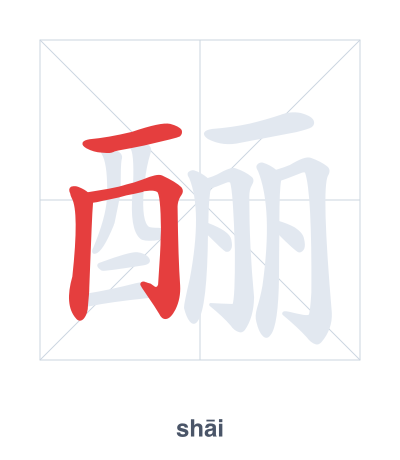
Open Hanzi Writer to see the animated stroke order and practice writing 酾 with real-time feedback.
The character 酾 (shāi) is written with 14 strokes. Follow the standard Chinese stroke order: top to bottom, left to right, outside before inside. The radical 酉 is one of its key components.
Practice the correct stroke order with the Hanzi Writer app to see animated stroke-by-stroke guidance with real-time feedback.
酾 means to strain or pour wine.
The left radical 酉 (wine jar) indicates the character relates to alcoholic beverages. The right component 丽 (beautiful) originally served as a phonetic hint in the traditional form 釃 (from 麗), though the modern pronunciation shifted, so it now functions as a structural element suggesting the elegance of the strained wine.
💡 Memory Tip: Picture a beautiful (丽) wine jar (酉) with a fine strainer on top—you pour the wine through it to get a clear, elegant drink.
诗人酾酒临江。
shī rén shāi jiǔ lín jiāng
The poet poured wine while overlooking the river.
这种酒需要酾滤。
zhè zhǒng jiǔ xū yào shāi lǜ
This wine needs to be strained and filtered.
泉水酾流而下。
quán shuǐ shāi liú ér xià
The spring water flows down as if being poured.
Open Hanzi Writer to see the animated stroke order and practice writing 酾 with real-time feedback.
✨ Animated stroke order · Handwriting recognition · HSK-graded practice · Free to use
The character 酾 is composed of the radical 酉 (wine jar) on the left and the phonetic component 丽 (lì, beautiful) on the right. The radical 酉 suggests a connection to alcohol, while the whole character specifically refers to the action of straining or pouring wine.