隡 (sà) means "Sa (used in transliterations)" in Chinese. It has 13 strokes with the radical 阝.
Rated 3.9/5 in difficulty (challenging).
Appears in 3+ common words including 隡陀 (sà tuó), 隡那 (sà nà), 隡马 (sà mǎ).
Due to its 13 strokes, Hanzi Writer's error detection shows 隡 requires focused practice — most learners need 10+ attempts for consistent accuracy.
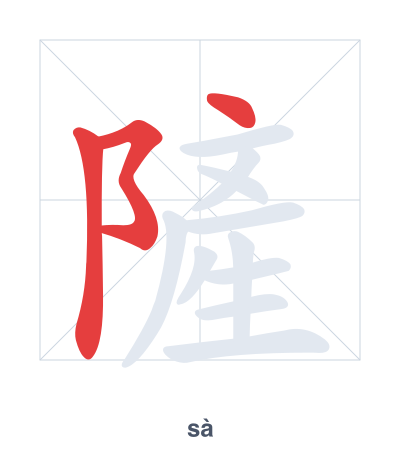
Open Hanzi Writer to see the animated stroke order and practice writing 隡 with real-time feedback.
The character 隡 (sà) is written with 13 strokes. Follow the standard Chinese stroke order: top to bottom, left to right, outside before inside. The radical 阝 is one of its key components.
Practice the correct stroke order with the Hanzi Writer app to see animated stroke-by-stroke guidance with real-time feedback.
隡 means Sa (used in transliterations).
隡 is a phono-semantic compound: the radical 阝 (hill) originally hinted at a place-related meaning, but in modern usage the character functions purely as a phonetic loan for the sound 'sa' in transliterations. The right component 㐭 (sè) contributes only to the pronunciation, not the meaning.
💡 Memory Tip: Picture a hill (阝) with a strange box (㐭) on top that has a big red 'SA' sticker, used to label a foreign place name.
隡陀是一个古词。
sà tuó shì yí gè gǔ cí
Satuo is an ancient word.
隡那听起来很安静。
sà nà tīng qǐ lái hěn ān jìng
Sana sounds very quiet.
隡马在草原上跑。
sà mǎ zài cǎo yuán shàng pǎo
Sama runs on the grassland.
Open Hanzi Writer to see the animated stroke order and practice writing 隡 with real-time feedback.
✨ Animated stroke order · Handwriting recognition · HSK-graded practice · Free to use
隡 is composed of the radical 阝 (meaning 'hill' or 'place') on the left and a phonetic component on the right that indicates the sound 'sà'. Since 隡 is only used for transliterating foreign sounds, the meaning comes from its pronunciation, not from the radical.