陀 (tuó) means "steep / (used in transliterations)" in Chinese. It has 7 strokes with the radical 阝.
Rated 3.2/5 in difficulty (challenging).
Appears in 3+ common words including 陀螺 (tuó luó), 佛陀 (fó tuó), 陀螺仪 (tuó luó yí).
Due to its 7 strokes, Hanzi Writer's error detection shows 陀 requires focused practice — most learners need 10+ attempts for consistent accuracy.
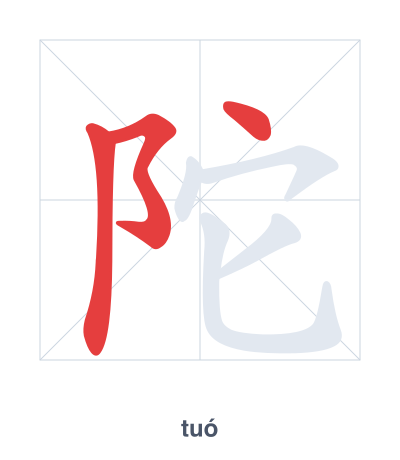
Open Hanzi Writer to see the animated stroke order and practice writing 陀 with real-time feedback.
The character 陀 (tuó) is written with 7 strokes. Follow the standard Chinese stroke order: top to bottom, left to right, outside before inside. The radical 阝 is one of its key components.
Practice the correct stroke order with the Hanzi Writer app to see animated stroke-by-stroke guidance with real-time feedback.
陀 means steep / (used in transliterations).
陀 combines the radical 阝 (mound or steep hill) with 它 (a snake) as a phonetic component. Originally meaning a steep slope or cliff, the character uses the hill radical to indicate terrain while 它 provides pronunciation. It is also commonly used in transliterations, such as 陀螺 (tuó luó, a spinning top).
💡 Memory Tip: On a steep hill (阝), a snake (它) slithers dangerously, struggling not to slide down.
孩子在玩陀螺。
hái zi zài wán tuó luó
The child is playing with a spinning top.
佛陀是智慧的象征。
fó tuó shì zhì huì de xiàng zhēng
Buddha is a symbol of wisdom.
手机里有陀螺仪。
shǒu jī lǐ yǒu tuó luó yí
There is a gyroscope in the phone.
Open Hanzi Writer to see the animated stroke order and practice writing 陀 with real-time feedback.
✨ Animated stroke order · Handwriting recognition · HSK-graded practice · Free to use
The left component is 阝 (the 'left ear' radical), which represents a hill or mound. The right component is 它 (tā, meaning 'it'), which gives the sound. Together they form a character originally meaning 'steep hill,' but today 陀 is mostly used in transliterations and compound words.