媷 (rù) means "to insult; to be lazy" in Chinese. It has 13 strokes with the radical 女.
Rated 4.2/5 in difficulty (advanced).
Appears in 3+ common words including 媷恼 (rù nǎo), 媷劳 (rù láo), 繁媷 (fán rù).
Due to its 13 strokes, Hanzi Writer's error detection shows 媷 requires focused practice — most learners need 10+ attempts for consistent accuracy.
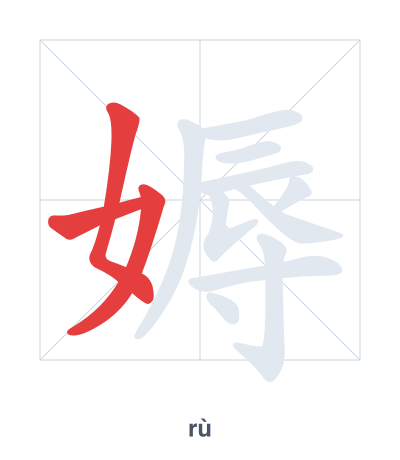
Open Hanzi Writer to see the animated stroke order and practice writing 媷 with real-time feedback.
The character 媷 (rù) is written with 13 strokes. Follow the standard Chinese stroke order: top to bottom, left to right, outside before inside. The radical 女 is one of its key components.
Practice the correct stroke order with the Hanzi Writer app to see animated stroke-by-stroke guidance with real-time feedback.
媷 means to insult; to be lazy.
The character 媷 is a semantic-phonetic compound: the radical 女 (woman) hints at a person, while 辱 (rǔ, meaning 'to insult') provides both the sound and the core meaning of insulting or being lazy—originally describing a woman who neglects her duties.
💡 Memory Tip: Picture a woman (女) insulting her helper by lazily pointing at a clock (辰) with her finger (寸), blaming time for her inaction.
这件事让他很媷恼。
zhè jiàn shì ràng tā hěn rù nǎo
This matter made him very annoyed.
身体媷劳需要休息。
shēn tǐ rù láo xū yào xiū xī
The body is overworked and needs rest.
礼节不要太繁媷。
lǐ jié bú yào tài fán rù
Etiquette should not be too cumbersome.
Open Hanzi Writer to see the animated stroke order and practice writing 媷 with real-time feedback.
✨ Animated stroke order · Handwriting recognition · HSK-graded practice · Free to use
The left side of 媷 is the radical 女 (woman), which indicates a feminine context. The right side is 辱 (rǔ), meaning shame or disgrace, so together the character suggests actions like insulting or being lazy that bring shame.