罂 (yīng) means "long-necked jar" in Chinese. It has 14 strokes with the radical 缶.
Rated 3.8/5 in difficulty (challenging).
Appears in 3+ common words including 罂粟 (yīng sù), 罂瓶 (yīng píng), 陶罂 (táo yīng).
Due to its 14 strokes, Hanzi Writer's error detection shows 罂 requires focused practice — most learners need 10+ attempts for consistent accuracy.
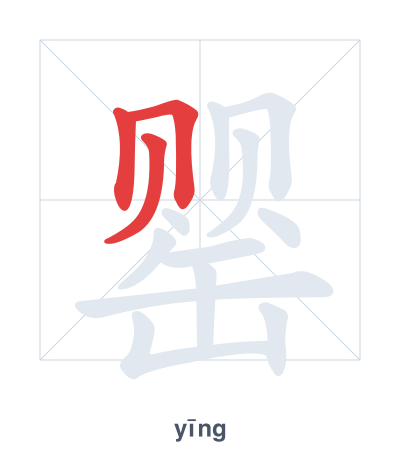
Open Hanzi Writer to see the animated stroke order and practice writing 罂 with real-time feedback.
The character 罂 (yīng) is written with 14 strokes. Follow the standard Chinese stroke order: top to bottom, left to right, outside before inside. The radical 缶 is one of its key components.
Practice the correct stroke order with the Hanzi Writer app to see animated stroke-by-stroke guidance with real-time feedback.
罂 means long-necked jar.
| Character | 罂 |
| Pinyin | yīng (ying) |
| Meaning | long-necked jar |
| Strokes | 14 |
| Radical | 缶 |
| Difficulty | 3.8/5 |
罂 is a compound character. The radical 缶 (fou) depicts an earthenware jar, indicating the meaning of a vessel. The component 賏 (yīng) originally means a string of pearls or shells, and here provides the sound, while its two 贝 (shell) shapes visually suggest the long, narrow neck of the jar.
💡 Memory Tip: Imagine a tall jar (缶) wearing two shiny shells (贝贝) as earrings on its long neck.
罂粟花很漂亮。
yīng sù huā hěn piào liàng
Poppies are very beautiful.
这是一个小罂瓶。
zhè shì yí gè xiǎo yīng píng
This is a small jar or bottle.
这是一个陶罂。
zhè shì yí gè táo yīng
This is a pottery jar.
Open Hanzi Writer to see the animated stroke order and practice writing 罂 with real-time feedback.
✨ Animated stroke order · Handwriting recognition · HSK-graded practice · Free to use
罂 is made of two parts: the left radical 缶 (fǒu), meaning earthenware or pottery, and the right component 賏 (yīng). The radical directly hints that the character refers to a type of pottery container, specifically a long-necked jar or jug.