罄 (qìng) means "exhausted / empty" in Chinese. It has 17 strokes with the radical 缶.
Rated 4.2/5 in difficulty (advanced).
Appears in 3+ common words including 售罄 (shòu qìng), 告罄 (gào qìng), 罄尽 (qìng jìn).
Due to its 17 strokes, Hanzi Writer's error detection shows 罄 requires focused practice — most learners need 10+ attempts for consistent accuracy.
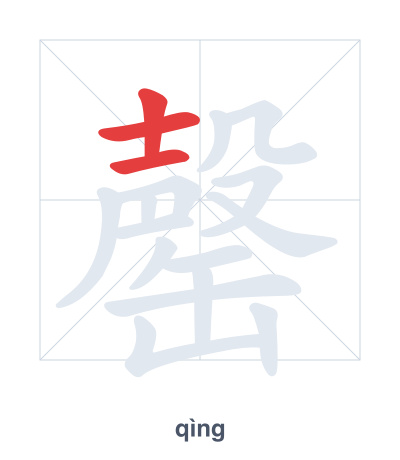
Open Hanzi Writer to see the animated stroke order and practice writing 罄 with real-time feedback.
The character 罄 (qìng) is written with 17 strokes. Follow the standard Chinese stroke order: top to bottom, left to right, outside before inside. The radical 缶 is one of its key components.
Practice the correct stroke order with the Hanzi Writer app to see animated stroke-by-stroke guidance with real-time feedback.
罄 means exhausted / empty.
| Character | 罄 |
| Pinyin | qìng (qing) |
| Meaning | exhausted / empty |
| Strokes | 17 |
| Radical | 缶 |
| Difficulty | 4.2/5 |
罄 combines 缶 (a pottery jar) and 殸 (sound of striking a stone). When an empty jar is struck, it makes a ringing sound, so the character came to mean 'exhausted' or 'empty'.
💡 Memory Tip: Imagine dropping a stone (殸) into a clay jar (缶) and hearing a hollow echo because the jar is completely empty.
门票已经售罄了。
mén piào yǐ jīng shòu qìng le
The tickets are already sold out.
商店的货源告罄。
shāng diàn de huò yuán gào qìng
The store's stock is sold out.
他的力气已经罄尽。
tā de lì qì yǐ jīng qìng jìn
His strength is completely exhausted.
Open Hanzi Writer to see the animated stroke order and practice writing 罄 with real-time feedback.
✨ Animated stroke order · Handwriting recognition · HSK-graded practice · Free to use
罄 is composed of the radical 缶 (pottery vessel) on the bottom and the component 殸 on top. The pottery vessel represents a container, and the top part suggests something that has been struck or emptied, so together they mean "exhausted" or "empty."