诠 (quán) means "to explain; to annotate" in Chinese. It has 8 strokes with the radical 讠.
Rated 3.4/5 in difficulty (challenging).
Appears in 3+ common words including 诠释 (quán shì), 诠注 (quán zhù), 真诠 (zhēn quán).
Due to its 8 strokes, Hanzi Writer's error detection shows 诠 requires focused practice — most learners need 10+ attempts for consistent accuracy.
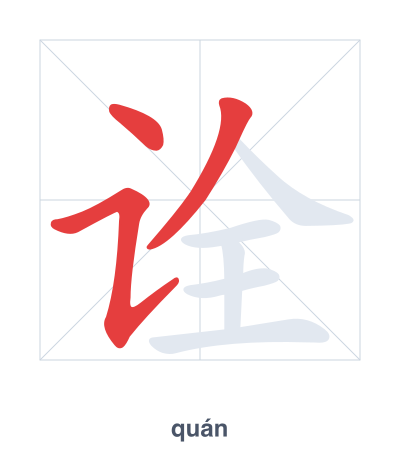
Open Hanzi Writer to see the animated stroke order and practice writing 诠 with real-time feedback.
The character 诠 (quán) is written with 8 strokes. Follow the standard Chinese stroke order: top to bottom, left to right, outside before inside. The radical 讠 is one of its key components.
Practice the correct stroke order with the Hanzi Writer app to see animated stroke-by-stroke guidance with real-time feedback.
诠 means to explain; to annotate.
诠 is a compound character combining the radical 讠 (speech) with 全 (complete, whole). The radical suggests verbal communication, while 全 implies a thorough or complete explanation, together meaning 'to annotate or explain in full detail.'
💡 Memory Tip: Imagine a speaker (讠) giving a complete (全) breakdown of a topic, leaving nothing unexplained.
他诠释得很好。
tā quán shì dé hěn hǎo
He explained it very well.
这本书有详细诠注。
zhè běn shū yǒu xiáng xì quán zhù
This book has detailed annotations.
这是人生的真诠。
zhè shì rén shēng de zhēn quán
This is the true meaning of life.
Open Hanzi Writer to see the animated stroke order and practice writing 诠 with real-time feedback.
✨ Animated stroke order · Handwriting recognition · HSK-graded practice · Free to use
诠 is made of the radical 讠, meaning 'speech' or 'words,' and the component 全, meaning 'whole' or 'complete.' Together, they suggest using words to make something fully understood — that is, to explain or annotate thoroughly.