赇 (qiú) means "bribe" in Chinese. It has 11 strokes with the radical 贝.
Rated 4.2/5 in difficulty (advanced).
Appears in 3+ common words including 贿赇 (huì qiú), 贪赇 (tān qiú), 受赇 (shòu qiú).
Due to its 11 strokes, Hanzi Writer's error detection shows 赇 requires focused practice — most learners need 10+ attempts for consistent accuracy.
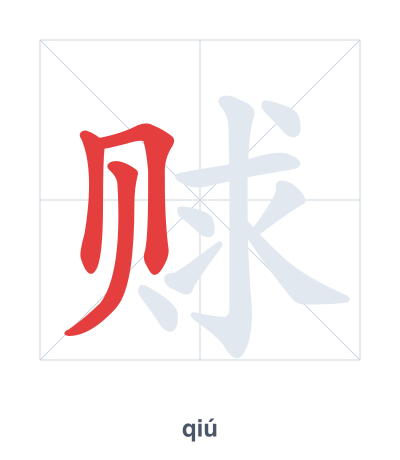
Open Hanzi Writer to see the animated stroke order and practice writing 赇 with real-time feedback.
The character 赇 (qiú) is written with 11 strokes. Follow the standard Chinese stroke order: top to bottom, left to right, outside before inside. The radical 贝 is one of its key components.
Practice the correct stroke order with the Hanzi Writer app to see animated stroke-by-stroke guidance with real-time feedback.
赇 means bribe.
This character is a phono-semantic compound. The left side, 贝 (shell, money), indicates that the meaning involves wealth. The right side, 求 (qiú, 'to seek'), provides the pronunciation and contributes the idea of seeking or requesting. Together, they depict seeking money through improper means, i.e., offering a bribe.
💡 Memory Tip: Picture a hand (resembling 求) reaching out for a shell (贝) to slip it to an official as a secret bribe.
法律严禁贿赇行为。
fǎ lǜ yán jìn huì qiú xíng wéi
The law strictly prohibits bribery.
他因贪赇被撤职了。
tā yīn tān qiú bèi chè zhí le
He was dismissed from his post for taking bribes.
受赇者会受到惩罚。
shòu qiú zhě huì shòu dào chéng fá
Those who accept bribes will be punished.
Open Hanzi Writer to see the animated stroke order and practice writing 赇 with real-time feedback.
✨ Animated stroke order · Handwriting recognition · HSK-graded practice · Free to use
赇 is composed of the radical 贝 (shell/money) on the left and the phonetic component 求 (qiú, meaning 'to beg' or 'request') on the right. The 贝 radical indicates money or wealth, and 求 suggests the action of seeking, together implying seeking money through dishonest means, i.e., bribery.