贰 (èr) means "Two (formal/financial form) / Disloyalty" in Chinese. It has 9 strokes with the radical 贝.
Rated 4/5 in difficulty (challenging).
Appears in 3+ common words including 贰万 (èr wàn), 贰拾 (èr shí), 贰心 (èr xīn).
Due to its 9 strokes, Hanzi Writer's error detection shows 贰 requires focused practice — most learners need 10+ attempts for consistent accuracy.
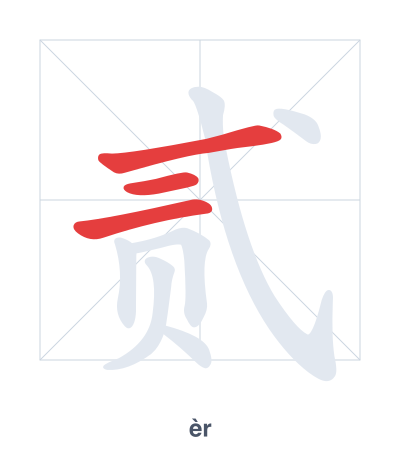
Open Hanzi Writer to see the animated stroke order and practice writing 贰 with real-time feedback.
The character 贰 (èr) is written with 9 strokes. Follow the standard Chinese stroke order: top to bottom, left to right, outside before inside. The radical 贝 is one of its key components.
Practice the correct stroke order with the Hanzi Writer app to see animated stroke-by-stroke guidance with real-time feedback.
贰 means Two (formal/financial form) / Disloyalty.
贰 is a compound of 二 (two) and 贝 (shell/money), originally depicting two pieces of shell currency used in formal financial writing. The meaning 'disloyalty' derives from the idea of being 'double' or 'second' in allegiance, as in having two masters.
💡 Memory Tip: Imagine two shell coins (贝) with a long horizontal line (like a tightrope) above them: if you try to juggle both, you'll fall into disloyalty.
支票上写着贰万元。
zhī piào shàng xiě zhe èr wàn yuán
The check says twenty thousand yuan.
这件衣服贰拾块钱。
zhè jiàn yī fú èr shí kuài qián
This piece of clothing is twenty yuan.
他对公司没有贰心。
tā duì gōng sī méi yǒu èr xīn
He has no disloyalty toward the company.
Open Hanzi Writer to see the animated stroke order and practice writing 贰 with real-time feedback.
✨ Animated stroke order · Handwriting recognition · HSK-graded practice · Free to use
贰 is composed of three parts: the top 二 (two), the middle 贝 (shell, representing money), and a bottom hook-like component (弋). The 二 directly indicates the number two, while 贝 connects it to financial contexts, as shells were ancient currency. The bottom part is a phonetic element and helps form the shape.