蜻 (qīng) means "Dragonfly" in Chinese. It has 14 strokes with the radical 虫.
Rated 4.2/5 in difficulty (advanced).
Appears in 3+ common words including 蜻蜓 (qīng tíng), 蜻蜓点水 (qīng tíng diǎn shuǐ), 小蜻蜓 (xiǎo qīng tíng).
Due to its 14 strokes, Hanzi Writer's error detection shows 蜻 requires focused practice — most learners need 10+ attempts for consistent accuracy.
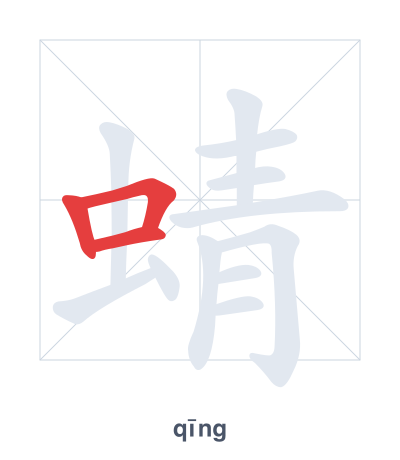
Open Hanzi Writer to see the animated stroke order and practice writing 蜻 with real-time feedback.
The character 蜻 (qīng) is written with 14 strokes. Follow the standard Chinese stroke order: top to bottom, left to right, outside before inside. The radical 虫 is one of its key components.
Practice the correct stroke order with the Hanzi Writer app to see animated stroke-by-stroke guidance with real-time feedback.
蜻 means Dragonfly.
蜻 is a phono-semantic compound: the radical 虫 (insect) marks it as a type of insect, while the phonetic component 青 (qīng, meaning green/blue) suggests the dragonfly's common coloration.
💡 Memory Tip: Picture a dragonfly (虫) with a shimmering green (青) body flying over a pond.
蜻蜓在水面飞。
qīng tíng zài shuǐ miàn fēi
The dragonfly is flying over the water surface.
学习不能蜻蜓点水。
xué xí bù néng qīng tíng diǎn shuǐ
Learning should not be superficial.
小蜻蜓很漂亮。
xiǎo qīng tíng hěn piào liàng
The small dragonfly is very beautiful.
Open Hanzi Writer to see the animated stroke order and practice writing 蜻 with real-time feedback.
✨ Animated stroke order · Handwriting recognition · HSK-graded practice · Free to use
蜻 is composed of the radical 虫 (insect) on the left and the phonetic component 青 (qīng) on the right. The 虫 part indicates that its meaning is related to insects, while 青 provides the pronunciation and also hints at the dragonfly's typical green or blue color.