蜓 (tíng) means "dragonfly (component)" in Chinese. It has 12 strokes with the radical 虫.
Rated 4.2/5 in difficulty (advanced).
Appears in 3+ common words including 蜻蜓 (qīng tíng), 蜻蜓点水 (qīng tíng diǎn shuǐ), 玉蜓 (yù tíng).
Due to its 12 strokes, Hanzi Writer's error detection shows 蜓 requires focused practice — most learners need 10+ attempts for consistent accuracy.
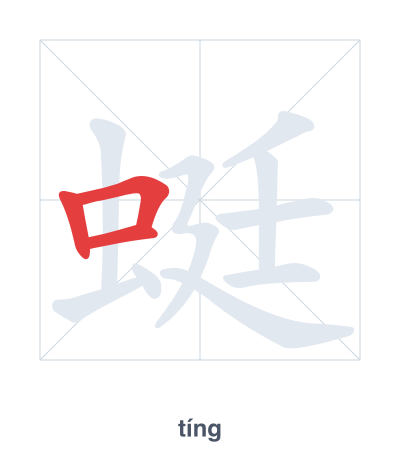
Open Hanzi Writer to see the animated stroke order and practice writing 蜓 with real-time feedback.
The character 蜓 (tíng) is written with 12 strokes. Follow the standard Chinese stroke order: top to bottom, left to right, outside before inside. The radical 虫 is one of its key components.
Practice the correct stroke order with the Hanzi Writer app to see animated stroke-by-stroke guidance with real-time feedback.
蜓 means dragonfly (component).
蜓 combines the radical 虫 (insect) with the phonetic component 廷 (tíng), which originally meant 'court' or 'palace'. The character visually shows an insect (虫) beside a sound symbol (廷), indicating it is a type of insect whose name sounds like 'tíng'.
💡 Memory Tip: Imagine a dragonfly landing on the emperor's court (廷) in the palace, its long tail pointing like a royal scepter, while the insect radical 虫 reminds you it's a bug.
湖边有很多蜻蜓。
hú biān yǒu hěn duō qīng tíng
There are many dragonflies by the lake.
蜻蜓点水非常漂亮。
qīng tíng diǎn shuǐ fēi cháng piào liàng
The dragonfly skimming the water is very beautiful.
这是一个玉蜓发簪。
zhè shì yí gè yù tíng fā zān
This is a jade dragonfly hairpin.
Open Hanzi Writer to see the animated stroke order and practice writing 蜓 with real-time feedback.
✨ Animated stroke order · Handwriting recognition · HSK-graded practice · Free to use
蜓 is a pictophonetic character. The left part 虫 (chóng) is the radical meaning 'insect' or 'worm', indicating the character belongs to the insect category. The right part 廷 (tíng) provides the pronunciation and originally meant 'court' or 'palace', but here it's purely phonetic. So the structure tells you it's an insect pronounced 'tíng'.