唚 (qìn) means "To kiss" in Chinese. It has 10 strokes with the radical 口.
Rated 4.2/5 in difficulty (advanced).
Appears in 3+ common words including 唚 (qìn), 唚气 (qìn qì), 唚口 (qìn kǒu).
Due to its 10 strokes, Hanzi Writer's error detection shows 唚 requires focused practice — most learners need 10+ attempts for consistent accuracy.
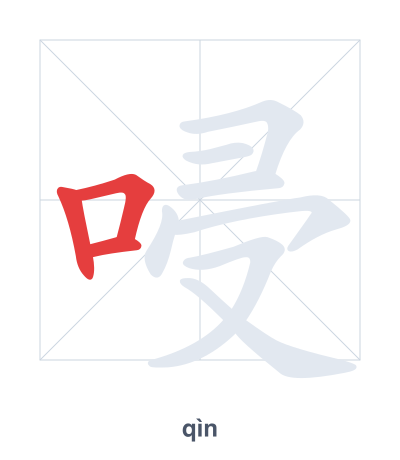
Open Hanzi Writer to see the animated stroke order and practice writing 唚 with real-time feedback.
The character 唚 (qìn) is written with 10 strokes. Follow the standard Chinese stroke order: top to bottom, left to right, outside before inside. The radical 口 is one of its key components.
Practice the correct stroke order with the Hanzi Writer app to see animated stroke-by-stroke guidance with real-time feedback.
唚 means To kiss.
This phono-semantic compound combines 口 (mouth) with 亲 (close, intimate). The mouth radical indicates the action of kissing, while 亲 provides the pronunciation 'qìn' and hints at the closeness involved.
💡 Memory Tip: Picture a dear one (亲: a person standing 立 under a tree 木) puckering their mouth (口) toward you for a kiss.
他在小声唚。
tā zài xiǎo shēng qìn
He is muttering nonsense softly.
他在唉声唚气。
tā zài āi shēng qìn qì
He is sighing and moaning.
他的唚口很重。
tā de qìn kǒu hěn zhòng
He has a foul mouth.
Open Hanzi Writer to see the animated stroke order and practice writing 唚 with real-time feedback.
✨ Animated stroke order · Handwriting recognition · HSK-graded practice · Free to use
唚 is made of the mouth radical 口 on the left and 亲 (qīn, meaning close or relative) on the right. The mouth radical shows that the action involves the mouth, and 亲 adds the idea of intimacy, so together they mean "to kiss."