檎 (qín) means "wild apple; crabapple" in Chinese. It has 16 strokes with the radical 木.
Rated 4.2/5 in difficulty (advanced).
Appears in 3+ common words including 林檎 (lín qín), 檎果 (qín guǒ), 山檎 (shān qín).
Due to its 16 strokes, Hanzi Writer's error detection shows 檎 requires focused practice — most learners need 10+ attempts for consistent accuracy.
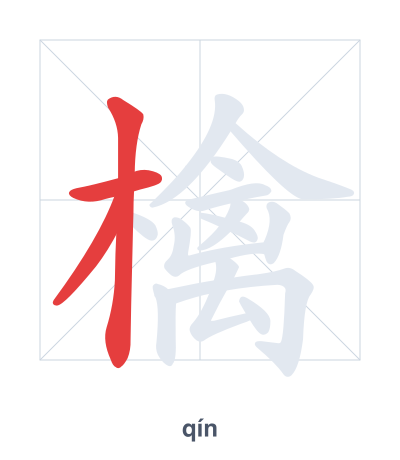
Open Hanzi Writer to see the animated stroke order and practice writing 檎 with real-time feedback.
The character 檎 (qín) is written with 16 strokes. Follow the standard Chinese stroke order: top to bottom, left to right, outside before inside. The radical 木 is one of its key components.
Practice the correct stroke order with the Hanzi Writer app to see animated stroke-by-stroke guidance with real-time feedback.
檎 means wild apple; crabapple.
檎 is a phono-semantic compound. The radical 木 means 'tree,' and the phonetic component 禽 (meaning 'bird') hints at the pronunciation and suggests that birds eat the fruit of this tree. Thus, it signifies a wild apple or crabapple tree whose fruit attracts birds.
💡 Memory Tip: Imagine a tree (木) full of red crabapples, with a hungry bird (禽) perched on a branch taking a juicy bite.
他在果园里摘林檎。
tā zài guǒ yuán lǐ zhāi lín qín
He is picking crabapples in the orchard.
这里的檎果非常甜。
zhè lǐ de qín guǒ fēi cháng tián
The wild apples here are very sweet.
山檎长在山上。
shān qín zhǎng zài shān shàng
Wild apples grow on the mountain.
Open Hanzi Writer to see the animated stroke order and practice writing 檎 with real-time feedback.
✨ Animated stroke order · Handwriting recognition · HSK-graded practice · Free to use
The left side is 木, the radical for "tree," which shows this character relates to a type of tree or fruit. The right side is 禽 (qín), which adds the pronunciation and originally meant "bird" — possibly because birds like to eat crabapples.