初 (chū) means "beginning / initial / first" in Chinese. It has 7 strokes with the radical 刀, and is HSK Level 3.
Rated 3.2/5 in difficulty (challenging).
Harder than 27% of HSK Level 3 characters.
Appears in 3+ common words including 初级 (chū jí), 初中 (chū zhōng), 当初 (dāng chū).
Due to its 7 strokes, Hanzi Writer's error detection shows 初 requires focused practice — most learners need 10+ attempts for consistent accuracy.
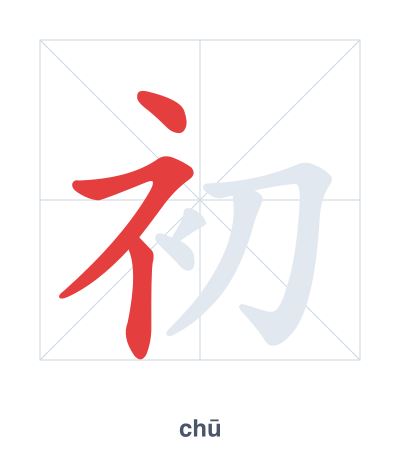
Open Hanzi Writer to see the animated stroke order and practice writing 初 with real-time feedback.
The character 初 (chū) is written with 7 strokes. Follow the standard Chinese stroke order: top to bottom, left to right, outside before inside. The radical 刀 is one of its key components.
Practice the correct stroke order with the Hanzi Writer app to see animated stroke-by-stroke guidance with real-time feedback.
初 means beginning / initial / first.
As an HSK Level 3 character, 初 is an intermediate-level character.
初 combines 衤 (clothing) on the left and 刀 (knife) on the right. The original meaning was 'to cut cloth'—the first step in making clothes—hence extending to 'beginning' or 'initial.'
💡 Memory Tip: Imagine a tailor using a knife (刀) to make the first cut into a piece of cloth (衤)—that's the beginning of a new garment.
我在读初级汉语。
wǒ zài dú chū jí hàn yǔ
I am studying elementary Chinese.
我弟弟在上初中。
wǒ dì di zài shàng chū zhōng
My younger brother is in junior high school.
当初他就在这里。
dāng chū tā jiù zài zhè lǐ
He was right here at that time.
Open Hanzi Writer to see the animated stroke order and practice writing 初 with real-time feedback.
✨ Animated stroke order · Handwriting recognition · HSK-graded practice · Free to use
初 combines the clothing radical 衤 (from 衣) on the left and the knife radical 刀 on the right. The image is of a knife cutting cloth, which is the first step in making clothes — hence the meaning of "beginning" or "first."