樵 (qiáo) means "firewood" in Chinese. It has 16 strokes with the radical 木.
Rated 4.2/5 in difficulty (advanced).
Appears in 3+ common words including 樵夫 (qiáo fū), 樵采 (qiáo cǎi), 樵路 (qiáo lù).
Due to its 16 strokes, Hanzi Writer's error detection shows 樵 requires focused practice — most learners need 10+ attempts for consistent accuracy.
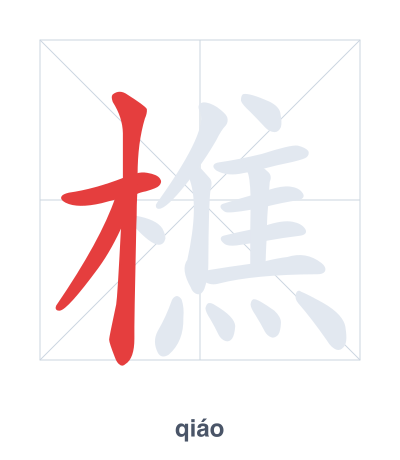
Open Hanzi Writer to see the animated stroke order and practice writing 樵 with real-time feedback.
The character 樵 (qiáo) is written with 16 strokes. Follow the standard Chinese stroke order: top to bottom, left to right, outside before inside. The radical 木 is one of its key components.
Practice the correct stroke order with the Hanzi Writer app to see animated stroke-by-stroke guidance with real-time feedback.
樵 means firewood.
樵 is a compound character with the radical 木 (tree/wood) and the phonetic component 焦 (scorched/burnt). The tree radical indicates the character's connection to wood, while 焦 suggests that the wood is dried or burnt for use as fuel, thus forming the meaning 'firewood.'
💡 Memory Tip: Imagine a tree (木) under a blazing sun (the 'scorched' idea from 焦) turning into dry firewood ready for the hearth.
樵夫在山上砍柴。
qiáo fū zài shān shàng kǎn chái
The woodcutter is chopping wood on the mountain.
他每天上山樵采。
tā měi tiān shàng shān qiáo cǎi
He goes to the mountains every day to gather firewood.
这是一条山中小樵路。
zhè shì yī tiáo shān zhōng xiǎo qiáo lù
This is a small woodcutter's path in the mountains.
Open Hanzi Writer to see the animated stroke order and practice writing 樵 with real-time feedback.
✨ Animated stroke order · Handwriting recognition · HSK-graded practice · Free to use
樵 is made of two parts: the radical 木 (tree) on the left, and 焦 (jiāo, meaning "scorched" or "burnt") on the right. Since firewood comes from trees and is often dried or burnt, the combination suggests wood that is ready for burning.