橇 (qiāo) means "sled" in Chinese. It has 16 strokes with the radical 木.
Rated 4.2/5 in difficulty (advanced).
Appears in 3+ common words including 雪橇 (xuě qiāo), 滑橇 (huá qiāo), 冰橇 (bīng qiāo).
Due to its 16 strokes, Hanzi Writer's error detection shows 橇 requires focused practice — most learners need 10+ attempts for consistent accuracy.
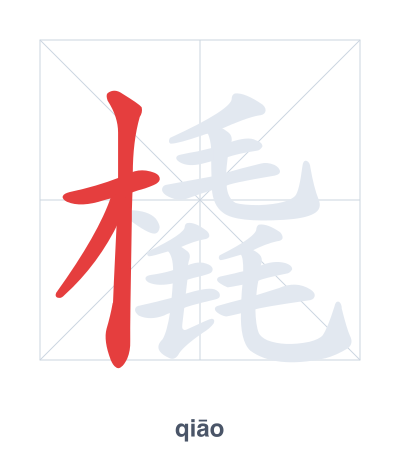
Open Hanzi Writer to see the animated stroke order and practice writing 橇 with real-time feedback.
The character 橇 (qiāo) is written with 16 strokes. Follow the standard Chinese stroke order: top to bottom, left to right, outside before inside. The radical 木 is one of its key components.
Practice the correct stroke order with the Hanzi Writer app to see animated stroke-by-stroke guidance with real-time feedback.
橇 means sled.
橇 is a compound character with the radical 木 (wood), indicating the material, and the component 毳 (cuì, fine hair or fur), which suggests the use of animal skins for smooth sliding. Ancient sleds were often made of wood and lined with fur to glide over snow or ice.
💡 Memory Tip: Picture a wooden sled (木) with three furry runners (the three hair-like strokes of 毳) zipping silently across a snowy hill.
孩子们在坐雪橇。
hái zi men zài zuò xuě qiāo
The children are riding a sled.
滑橇在雪地上移动。
huá qiāo zài xuě dì shàng yí dòng
The sled moves on the snow.
冰橇的速度非常快。
bīng qiāo de sù dù fēi cháng kuài
The sled is moving very fast.
Open Hanzi Writer to see the animated stroke order and practice writing 橇 with real-time feedback.
✨ Animated stroke order · Handwriting recognition · HSK-graded practice · Free to use
The character 橇 has the radical 木 (wood) on the left, which reminds us that traditional sleds were often made of wood. The right side is 毳, a rare component that looks like three layers of hair or fur; this might suggest the runners or the furry covering of a sled. Together, the left tells you the material, and the right gives an approximate sound (qiāo).