剳 (dá) means "sickle or hook-knife" in Chinese. It has 12 strokes with the radical 刂.
Rated 3.9/5 in difficulty (challenging).
Appears in 3+ common words including 剳记 (dá jì), 纸剳 (zhǐ dá), 剳子 (dá zi).
Due to its 12 strokes, Hanzi Writer's error detection shows 剳 requires focused practice — most learners need 10+ attempts for consistent accuracy.
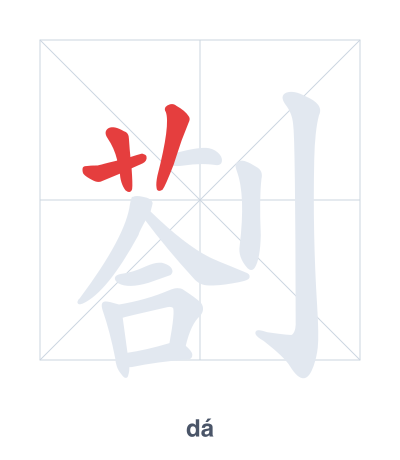
Open Hanzi Writer to see the animated stroke order and practice writing 剳 with real-time feedback.
The character 剳 (dá) is written with 12 strokes. Follow the standard Chinese stroke order: top to bottom, left to right, outside before inside. The radical 刂 is one of its key components.
Practice the correct stroke order with the Hanzi Writer app to see animated stroke-by-stroke guidance with real-time feedback.
剳 means sickle or hook-knife.
剳 is a phono-semantic compound where 荅 (dá) provides the sound and 刂 (knife radical) indicates its meaning as a cutting tool like a sickle or hook-knife. The left component 荅 combines grass (艹) and a container (合), possibly alluding to the curved blade that reaps grass.
💡 Memory Tip: Imagine a hook-knife (刂) slicing through a bundle of grass (艹) while a mouth (合) shouts 'Dá!' as it cuts.
他写了一本剳记。
tā xiě le yī běn dá jì
He wrote a book of study notes.
这里的纸剳很多。
zhè lǐ de zhǐ dá hěn duō
There are many notes and papers here.
他拿着一个剳子。
tā ná zhe yí gè dá zi
He was holding a sickle.
Open Hanzi Writer to see the animated stroke order and practice writing 剳 with real-time feedback.
✨ Animated stroke order · Handwriting recognition · HSK-graded practice · Free to use
The character 剳 has two parts: the left side is 荅 (dá, a phonetic component) and the right side is 刂, the 'knife' radical. The 刂 indicates a cutting tool, and together they form the meaning of a sickle or hook-knife. The 荅 gives the pronunciation, while the knife radical shows it is a tool for cutting.