掮 (qián) means "to carry on the shoulder" in Chinese. It has 11 strokes with the radical 扌.
Rated 4.2/5 in difficulty (advanced).
Appears in 3+ common words including 掮客 (qián kè), 掮着 (qián zhe), 掮东西 (qián dōng xī).
Due to its 11 strokes, Hanzi Writer's error detection shows 掮 requires focused practice — most learners need 10+ attempts for consistent accuracy.
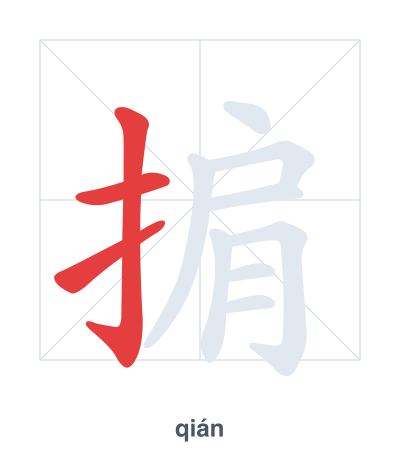
Open Hanzi Writer to see the animated stroke order and practice writing 掮 with real-time feedback.
The character 掮 (qián) is written with 11 strokes. Follow the standard Chinese stroke order: top to bottom, left to right, outside before inside. The radical 扌 is one of its key components.
Practice the correct stroke order with the Hanzi Writer app to see animated stroke-by-stroke guidance with real-time feedback.
掮 means to carry on the shoulder.
掮 is a compound character combining the hand radical 扌 (meaning hand or action) with 肩 (shoulder). The hand indicates the physical action, while the shoulder represents the body part used, together meaning 'to carry on the shoulder'.
💡 Memory Tip: Picture a hand (扌) lifting a heavy bag up onto a shoulder (肩) to carry it.
他是一个掮客。
tā shì yí gè qián kè
He is a broker.
他掮着一个袋子。
tā qián zhe yí gè dài zi
He is carrying a bag on his shoulder.
别掮太重的东西。
bié qián tài zhòng de dōng xī
Don't carry things that are too heavy.
Open Hanzi Writer to see the animated stroke order and practice writing 掮 with real-time feedback.
✨ Animated stroke order · Handwriting recognition · HSK-graded practice · Free to use
掮 combines the radical 扌 (hand) on the left with 肩 (shoulder) on the right. The hand radical shows an action, and 肩 provides the location, so together they mean "to carry on the shoulder."