髅 (lóu) means "skull" in Chinese. It has 18 strokes with the radical 骨.
Rated 4.2/5 in difficulty (advanced).
Appears in 3+ common words including 骷髅 (kū lóu), 骷髅头 (kū lóu tóu), 骷髅画 (kū lóu huà).
Due to its 18 strokes, Hanzi Writer's error detection shows 髅 requires focused practice — most learners need 10+ attempts for consistent accuracy.
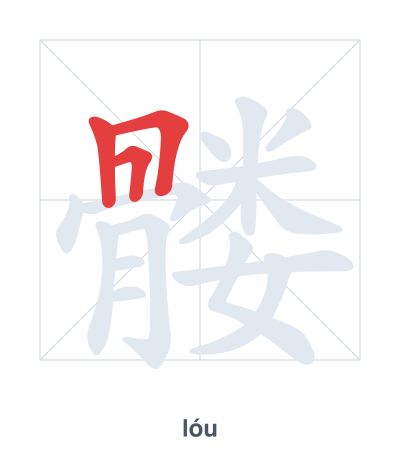
Open Hanzi Writer to see the animated stroke order and practice writing 髅 with real-time feedback.
The character 髅 (lóu) is written with 18 strokes. Follow the standard Chinese stroke order: top to bottom, left to right, outside before inside. The radical 骨 is one of its key components.
Practice the correct stroke order with the Hanzi Writer app to see animated stroke-by-stroke guidance with real-time feedback.
髅 means skull.
| Character | 髅 |
| Pinyin | lóu (lou) |
| Meaning | skull |
| Strokes | 18 |
| Radical | 骨 |
| Difficulty | 4.2/5 |
髅 is a phono-semantic compound: the left side 骨 (bone) indicates the meaning relates to bones, specifically the skull, while the right side 婁 (lóu) provides the pronunciation. This character appears in the compound 骷髅 (kūlóu), meaning 'skeleton' or 'skull'.
💡 Memory Tip: Imagine a skull made of bone (骨) with a huge jaw hanging open like a crazy laugh—‘lóu, lóu, lóu!’
海盗旗上有骷髅。
hǎi dào qí shàng yǒu kū lóu
There is a skull on the pirate flag.
他买了一个骷髅头玩具。
tā mǎi le yí gè kū lóu tóu wán jù
He bought a skull toy.
这张骷髅画很酷。
zhè zhāng kū lóu huà hěn kù
This skeleton drawing is very cool.
Open Hanzi Writer to see the animated stroke order and practice writing 髅 with real-time feedback.
✨ Animated stroke order · Handwriting recognition · HSK-graded practice · Free to use
髅 is composed of the radical 骨 (bone) on the left and the phonetic component 娄 on the right. The bone radical shows that the character is related to bones or skeleton, while 娄 gives the pronunciation lóu. Together they form a character meaning 'skull' or 'skeleton.'