嵴 (jǐ) means "ridge" in Chinese. It has 13 strokes with the radical 山.
Rated 4.2/5 in difficulty (advanced).
Appears in 3+ common words including 山嵴 (shān jǐ), 嵴线 (jǐ xiàn), 牙嵴 (yá jǐ).
Due to its 13 strokes, Hanzi Writer's error detection shows 嵴 requires focused practice — most learners need 10+ attempts for consistent accuracy.
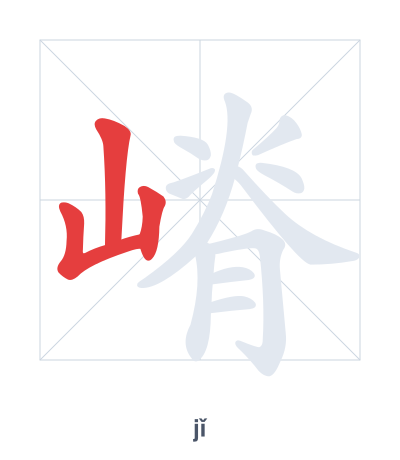
Open Hanzi Writer to see the animated stroke order and practice writing 嵴 with real-time feedback.
The character 嵴 (jǐ) is written with 13 strokes. Follow the standard Chinese stroke order: top to bottom, left to right, outside before inside. The radical 山 is one of its key components.
Practice the correct stroke order with the Hanzi Writer app to see animated stroke-by-stroke guidance with real-time feedback.
嵴 means ridge.
The character 嵴 combines the radical 山 (mountain) with 脊 (spine/ridge), where 脊 itself depicts a backbone. Together they create the meaning of a mountain's spine-like ridge.
💡 Memory Tip: Picture a mountain (山) with a long backbone (脊) stretching across its top, forming a distinct ridge.
山嵴上有很多绿树。
shān jǐ shàng yǒu hěn duō lǜ shù
There are many green trees on the mountain ridge.
我们沿着嵴线向上爬。
wǒ men yán zhe jǐ xiàn xiàng shàng pá
We climbed up along the ridge.
医生在检查他的牙嵴。
yī shēng zài jiǎn chá tā de yá jǐ
The doctor is examining his alveolar ridge.
Open Hanzi Writer to see the animated stroke order and practice writing 嵴 with real-time feedback.
✨ Animated stroke order · Handwriting recognition · HSK-graded practice · Free to use
The character 嵴 combines the radical 山 (mountain) on top with 脊 (spine) below. The 山 radical gives the meaning of mountain or hill, and 脊 contributes the sense of a backbone or spine, together forming the concept of a ridge. So 嵴 literally means a ridge that resembles the spine of a mountain.