Hanzi Writer

How to Write 俟 (qí) — Meaning “wait (literary)”

9 strokes Radical: 亻

俟 (qí) means "wait (literary)" in Chinese. It has 9 strokes with the radical 亻.

Rated 3.7/5 in difficulty (challenging).

Appears in 3+ common words including 俟机 (qí jī), 俟后 (qí hòu), 万俟 (mò qí).

Due to its 9 strokes, Hanzi Writer's error detection shows 俟 requires focused practice — most learners need 10+ attempts for consistent accuracy.
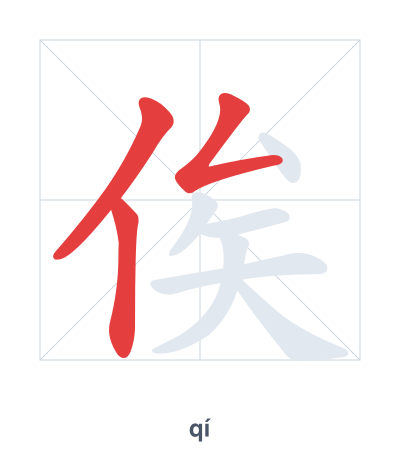
Stroke order practice for 俟 - qí

Practice Writing 俟 (qí)

Open Hanzi Writer to see the animated stroke order and practice writing 俟 with real-time feedback.

The character (qí) is written with 9 strokes. Follow the standard Chinese stroke order: top to bottom, left to right, outside before inside. The radical is one of its key components.

Practice the correct stroke order with the Hanzi Writer app to see animated stroke-by-stroke guidance with real-time feedback.

means wait (literary).

Character
Pinyinqí (qi)
Meaningwait (literary)
Strokes9
Radical
Difficulty3.7/5

This character is a compound of 亻 (person) and 矣 (a phonetic component). The person radical indicates that the meaning involves human action—here, standing by or waiting—while 矣 primarily gives the sound, with no direct visual link to the meaning.

💡 Memory Tip: Picture a person (亻) waiting with a cane (the 矣 part looks like a walking stick) for a late friend.

qí jī
wait for an opportunity
qí hòu
afterwards; later (literary)
mò qí
Moqi (a compound Chinese surname)

我们要俟机行动。

wǒ men yào qí jī xíng dòng

We must wait for the right opportunity to act.

详情俟后告知。

xiáng qíng qí hòu gào zhī

Details will be provided later.

他姓万俟。

tā xìng mò qí

His surname is Moqi.

Character Pinyin Strokes Radical
(current) 9
7
gū / gù 7
7
Stroke order practice for 俟 - qí

Practice Writing 俟 (qí)

Open Hanzi Writer to see the animated stroke order and practice writing 俟 with real-time feedback.

✨ Animated stroke order · Handwriting recognition · HSK-graded practice · Free to use

Frequently Asked Questions about 俟

俟 is composed of the radical 亻 (person) on the left and the phonetic component 矣 (yǐ) on the right. The radical suggests the character relates to a person or human action, while 矣 provides a phonetic clue. Together they form a literary word meaning 'to wait'.

Characters with Radical 亻

Other 9-Stroke Characters