沏 (qī) means "to brew; to infuse (tea or coffee)" in Chinese. It has 7 strokes with the radical 氵, and is HSK Level 7.
Rated 3.5/5 in difficulty (challenging).
Harder than 19% of HSK Level 7 characters.
Appears in 3+ common words including 沏茶 (qī chá), 沏咖啡 (qī kā fēi), 沏壶茶 (qī hú chá).
Due to its 7 strokes, Hanzi Writer's error detection shows 沏 requires focused practice — most learners need 10+ attempts for consistent accuracy.
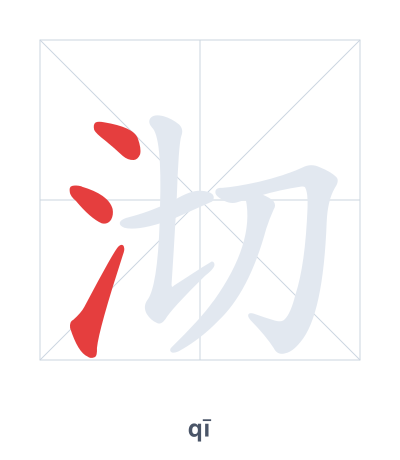
Open Hanzi Writer to see the animated stroke order and practice writing 沏 with real-time feedback.
The character 沏 (qī) is written with 7 strokes. Follow the standard Chinese stroke order: top to bottom, left to right, outside before inside. The radical 氵 is one of its key components.
Practice the correct stroke order with the Hanzi Writer app to see animated stroke-by-stroke guidance with real-time feedback.
沏 means to brew; to infuse (tea or coffee).
As an HSK Level 7 character, 沏 is an intermediate-level character.
沏 is a phono-semantic compound combining the water radical (氵) with the phonetic component 切 (qiē, 'to cut'). The water radical relates to the liquid used in brewing, while 切 suggests the action of pouring hot water to 'cut' into the tea leaves and extract their flavor.
💡 Memory Tip: Imagine cutting (切) a tea bag open with scissors over a cup of water (氵) to brew (沏) a fresh cup of tea.
我给你沏茶。
wǒ gěi nǐ qī chá
I'll make some tea for you.
妈妈在沏咖啡。
mā mā zài qī kā fēi
Mom is making coffee.
请帮我沏壶茶。
qǐng bāng wǒ qī hú chá 。
Please help me brew a pot of tea.
Open Hanzi Writer to see the animated stroke order and practice writing 沏 with real-time feedback.
✨ Animated stroke order · Handwriting recognition · HSK-graded practice · Free to use
沏 has the water radical 氵 on the left and the phonetic component 切 on the right. The water radical suggests that brewing involves hot water, while 切 provides pronunciation and hints at the action of extracting flavor, like cutting into tea leaves.