璞 (pú) means "Uncut jade; unpolished gem" in Chinese. It has 16 strokes with the radical 王.
Rated 4.2/5 in difficulty (advanced).
Appears in 3+ common words including 璞玉 (pú yù), 璞真 (pú zhēn), 返璞 (fǎn pú).
Due to its 16 strokes, Hanzi Writer's error detection shows 璞 requires focused practice — most learners need 10+ attempts for consistent accuracy.
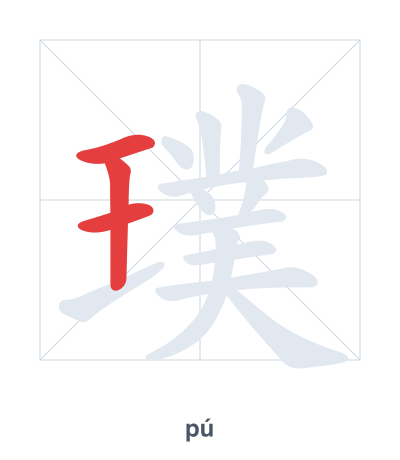
Open Hanzi Writer to see the animated stroke order and practice writing 璞 with real-time feedback.
The character 璞 (pú) is written with 16 strokes. Follow the standard Chinese stroke order: top to bottom, left to right, outside before inside. The radical 王 is one of its key components.
Practice the correct stroke order with the Hanzi Writer app to see animated stroke-by-stroke guidance with real-time feedback.
璞 means Uncut jade; unpolished gem.
The character 璞 combines the radical 王 (jade) on the left with 菐 (pú) on the right, which acts as a phonetic component and also suggests something rough or unrefined, like a bush. Together, they depict jade still encased in its natural stone, before any cutting or polishing.
💡 Memory Tip: Imagine a precious jade (王) hidden inside a wild bush (菐) — you have to hack through the thicket to find the unpolished gem.
他是一块待雕琢的璞玉。
tā shì yī kuài dài diāo zhuó de pú yù
He is a diamond in the rough.
他的性格非常璞真。
tā de xìng gé fēi cháng pú zhēn
He has a very simple and sincere personality.
生活应该返璞归真。
shēng huó yīng gāi fǎn pú guī zhēn
Life should return to its original simplicity.
Open Hanzi Writer to see the animated stroke order and practice writing 璞 with real-time feedback.
✨ Animated stroke order · Handwriting recognition · HSK-graded practice · Free to use
璞 is composed of the radical 王 (jade) on the left and the phonetic component 菐 on the right. The radical 王 tells you the character relates to jade, while the right part suggests the idea of something rough or unprocessed. Together, they represent uncut jade—a gem that has not yet been polished or carved.