瓿 (bù) means "small jar (ancient bronze or clay)" in Chinese. It has 12 strokes with the radical 瓦.
Rated 4.2/5 in difficulty (advanced).
Appears in 3+ common words including 铜瓿 (tóng bù), 陶瓿 (táo bù), 小瓿 (xiǎo bù).
Due to its 12 strokes, Hanzi Writer's error detection shows 瓿 requires focused practice — most learners need 10+ attempts for consistent accuracy.
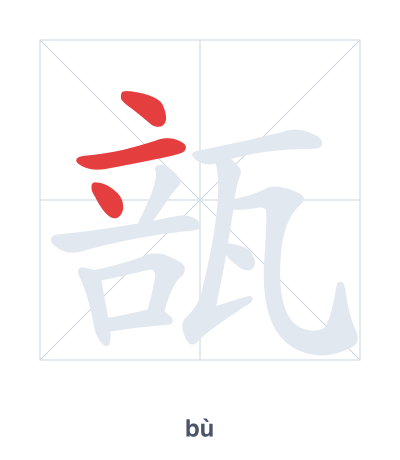
Open Hanzi Writer to see the animated stroke order and practice writing 瓿 with real-time feedback.
The character 瓿 (bù) is written with 12 strokes. Follow the standard Chinese stroke order: top to bottom, left to right, outside before inside. The radical 瓦 is one of its key components.
Practice the correct stroke order with the Hanzi Writer app to see animated stroke-by-stroke guidance with real-time feedback.
瓿 means small jar (ancient bronze or clay).
| Character | 瓿 |
| Pinyin | bù (bu) |
| Meaning | small jar (ancient bronze or clay) |
| Strokes | 12 |
| Radical | 瓦 |
| Difficulty | 4.2/5 |
瓿 is a phono-semantic compound where 瓦 (pottery/tile) indicates the material and 咅 (bù) provides the pronunciation. The character depicts a type of small jar or pot, often made of bronze or clay in ancient times.
💡 Memory Tip: Picture a small jar (瓦) with a loudspeaker (咅) on top, broadcasting that it contains ancient treasures.
这是一个古代的铜瓿。
zhè shì yí gè gǔ dài de tóng bù
This is an ancient bronze jar.
陶瓿里装着一些水。
táo bù lǐ zhuāng zhe yī xiē shuǐ
There is some water in the pottery jar.
柜子里放着一个小瓿。
guì zi lǐ fàng zhe yí gè xiǎo bù
There is a small jar in the cabinet.
Open Hanzi Writer to see the animated stroke order and practice writing 瓿 with real-time feedback.
✨ Animated stroke order · Handwriting recognition · HSK-graded practice · Free to use
The character 瓿 is made of two parts: the left part 咅 (pǒu) gives a hint to the pronunciation, and the right part 瓦 (wǎ) means "tile" or "pottery." Together, they indicate that 瓿 is a type of clay or bronze vessel, specifically a small jar.