瓮 (wèng) means "urn or large jar" in Chinese. It has 8 strokes with the radical 瓦.
Rated 3.7/5 in difficulty (challenging).
Appears in 3+ common words including 水瓮 (shuǐ wèng), 酒瓮 (jiǔ wèng), 瓮中 (wèng zhōng).
Due to its 8 strokes, Hanzi Writer's error detection shows 瓮 requires focused practice — most learners need 10+ attempts for consistent accuracy.
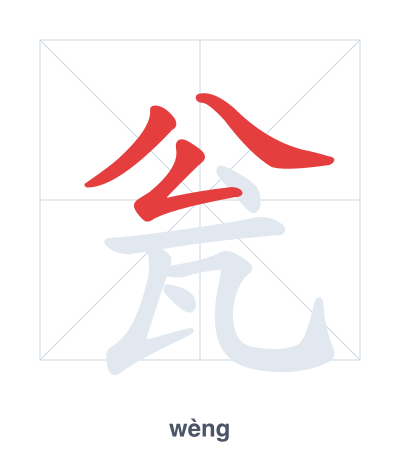
Open Hanzi Writer to see the animated stroke order and practice writing 瓮 with real-time feedback.
The character 瓮 (wèng) is written with 8 strokes. Follow the standard Chinese stroke order: top to bottom, left to right, outside before inside. The radical 瓦 is one of its key components.
Practice the correct stroke order with the Hanzi Writer app to see animated stroke-by-stroke guidance with real-time feedback.
瓮 means urn or large jar.
| Character | 瓮 |
| Pinyin | wèng (weng) |
| Meaning | urn or large jar |
| Strokes | 8 |
| Radical | 瓦 |
| Difficulty | 3.7/5 |
瓮 is a compound character: the radical 瓦 (clay pottery) indicates it's a vessel made from fired clay, while 公 (gōng) supplies the pronunciation. Together, they depict a large earthenware jar or urn, like those used in ancient China for storing water, grain, or wine.
💡 Memory Tip: Picture a giant clay jar with a sign that reads 'PUBLIC (公) POTTERY (瓦)'—everyone brings their wine to fill this communal urn.
水瓮里有水。
shuǐ wèng lǐ yǒu shuǐ
There is water in the water urn.
酒瓮很大。
jiǔ wèng hěn dà
The wine jar is very large.
瓮中捉鳖。
wèng zhōng zhuō biē
Like catching a turtle in a jar.
Open Hanzi Writer to see the animated stroke order and practice writing 瓮 with real-time feedback.
✨ Animated stroke order · Handwriting recognition · HSK-graded practice · Free to use
瓮 is made of the radical 瓦 (wǎ), meaning 'tile' or 'clay', above the component 公 (gōng). The radical indicates the material of the vessel (clay or pottery), while 公 provides a phonetic hint for the pronunciation wèng. Together they represent a large clay jar or urn.