蜱 (pí) means "Tick" in Chinese. It has 14 strokes with the radical 虫.
Rated 4.2/5 in difficulty (advanced).
Appears in 3+ common words including 蜱虫 (pí chóng), 蜱螨 (pí mǎn), 防蜱 (fáng pí).
Due to its 14 strokes, Hanzi Writer's error detection shows 蜱 requires focused practice — most learners need 10+ attempts for consistent accuracy.
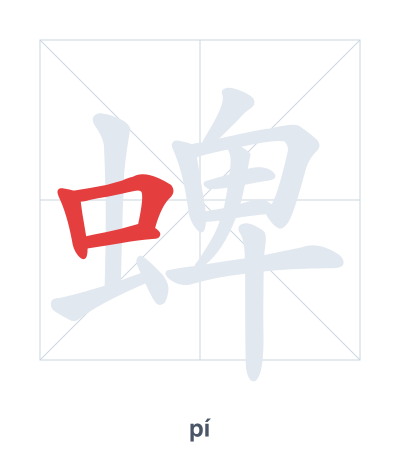
Open Hanzi Writer to see the animated stroke order and practice writing 蜱 with real-time feedback.
The character 蜱 (pí) is written with 14 strokes. Follow the standard Chinese stroke order: top to bottom, left to right, outside before inside. The radical 虫 is one of its key components.
Practice the correct stroke order with the Hanzi Writer app to see animated stroke-by-stroke guidance with real-time feedback.
蜱 means Tick.
蜱 is a phono-semantic compound: the radical 虫 (insect) marks it as a bug, while 卑 (bēi, meaning 'low' or 'humble') provides the phonetic cue and hints at the tick's lowly, parasitic nature, clinging close to the ground or host.
💡 Memory Tip: Imagine a tick (虫) so lowly (卑) that it humbly crawls along the grass, waiting to latch onto a passing animal.
蜱虫会咬人。
pí chóng huì yǎo rén
Ticks can bite people.
蜱螨寄生在身上。
pí mǎn jì shēng zài shēn shàng
Ticks and mites parasitize the body.
户外活动要防蜱。
hù wài huó dòng yào fáng pí
Beware of ticks during outdoor activities.
Open Hanzi Writer to see the animated stroke order and practice writing 蜱 with real-time feedback.
✨ Animated stroke order · Handwriting recognition · HSK-graded practice · Free to use
蜱 is made of the insect radical 虫 on the left and the phonetic component 卑 on the right. The radical shows it is a type of bug, and 卑 gives a clue to the pronunciation pí. Together they form the character for tick, a parasitic insect.