庞 (páng) means "Huge; enormous" in Chinese. It has 8 strokes with the radical 广, and is HSK Level 7.
Rated 3.7/5 in difficulty (challenging).
Harder than 25% of HSK Level 7 characters.
Appears in 3+ common words including 庞大 (páng dà), 面庞 (miàn páng), 庞杂 (páng zá).
Due to its 8 strokes, Hanzi Writer's error detection shows 庞 requires focused practice — most learners need 10+ attempts for consistent accuracy.
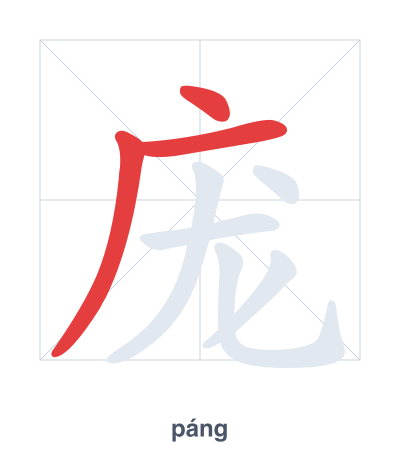
Open Hanzi Writer to see the animated stroke order and practice writing 庞 with real-time feedback.
The character 庞 (páng) is written with 8 strokes. Follow the standard Chinese stroke order: top to bottom, left to right, outside before inside. The radical 广 is one of its key components.
Practice the correct stroke order with the Hanzi Writer app to see animated stroke-by-stroke guidance with real-time feedback.
庞 means Huge; enormous.
As an HSK Level 7 character, 庞 is an intermediate-level character.
This character combines the roof radical 广 (shelter) with 龙 (dragon), a creature symbolizing immense power and size. Together, they evoke the image of a dragon so vast that even a large building cannot contain it, conveying the meaning 'huge' or 'enormous'.
💡 Memory Tip: Imagine a dragon (龙) stuck under a tiny roof (广), forcing the building to swell into a massive, towering structure.
这个计划很庞大。
zhè ge jì huà hěn páng dà
This plan is massive.
她的面庞很清秀。
tā de miàn páng hěn qīng xiù
Her face is delicate and pretty.
这里的机构很庞杂。
zhè lǐ de jī gòu hěn páng zá
The organization here is huge and complex.
Open Hanzi Writer to see the animated stroke order and practice writing 庞 with real-time feedback.
✨ Animated stroke order · Handwriting recognition · HSK-graded practice · Free to use
庞 has the radical 广 (rǒng, 'shelter' or 'house') on top and 龙 (lóng, 'dragon') below. The dragon is a large mythical creature, so the combination suggests something huge or enormous under a roof, giving the meaning 'huge' or 'vast'.