脲 (niào) means "urea" in Chinese. It has 11 strokes with the radical 月.
Rated 4.2/5 in difficulty (advanced).
Appears in 3+ common words including 脲素 (niào sù), 聚脲 (jù niào), 脲醛 (niào quán).
Due to its 11 strokes, Hanzi Writer's error detection shows 脲 requires focused practice — most learners need 10+ attempts for consistent accuracy.
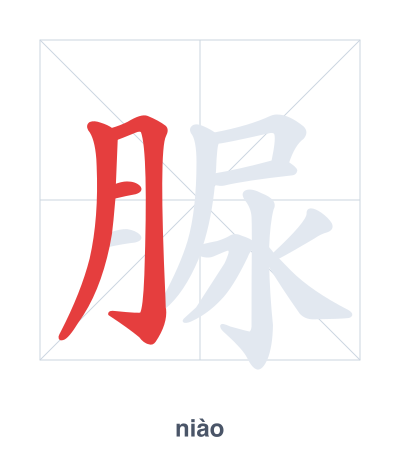
Open Hanzi Writer to see the animated stroke order and practice writing 脲 with real-time feedback.
The character 脲 (niào) is written with 11 strokes. Follow the standard Chinese stroke order: top to bottom, left to right, outside before inside. The radical 月 is one of its key components.
Practice the correct stroke order with the Hanzi Writer app to see animated stroke-by-stroke guidance with real-time feedback.
脲 means urea.
脲 is a compound character. The left radical 月 (flesh/body) indicates it relates to bodily substances, while the right component 尿 (urine) provides both sound and meaning, together forming 'urea'—a compound found in urine.
💡 Memory Tip: Picture a moon (月) floating in a puddle of urine (尿) to remember that urea comes from pee.
这种化肥含脲素。
zhè zhǒng huà féi hán niào sù
This fertilizer contains urea.
墙上涂了聚脲。
qiáng shàng tú le jù niào
The wall is coated with polyurea.
这是脲醛树脂。
zhè shì niào quán shù zhī
This is urea-formaldehyde resin.
Open Hanzi Writer to see the animated stroke order and practice writing 脲 with real-time feedback.
✨ Animated stroke order · Handwriting recognition · HSK-graded practice · Free to use
The character 脲 is made of two parts: on the left is the radical 月 (flesh or body), and on the right is 尿 (niào, urine). Together they suggest a substance related to urine found in the body — this is urea, a waste product from the kidneys.