匿 (nì) means "to hide; to conceal" in Chinese. It has 10 strokes with the radical 匚, and is HSK Level 7.
Rated 3.9/5 in difficulty (challenging).
Harder than 35% of HSK Level 7 characters.
Appears in 3+ common words including 匿名 (nì míng), 藏匿 (cáng nì), 匿名电话 (nì míng diàn huà).
Due to its 10 strokes, Hanzi Writer's error detection shows 匿 requires focused practice — most learners need 10+ attempts for consistent accuracy.
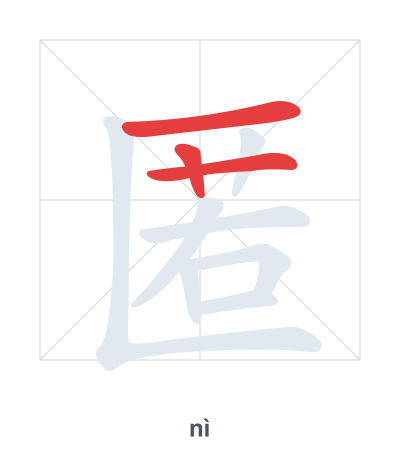
Open Hanzi Writer to see the animated stroke order and practice writing 匿 with real-time feedback.
The character 匿 (nì) is written with 10 strokes. Follow the standard Chinese stroke order: top to bottom, left to right, outside before inside. The radical 匚 is one of its key components.
Practice the correct stroke order with the Hanzi Writer app to see animated stroke-by-stroke guidance with real-time feedback.
匿 means to hide; to conceal.
As an HSK Level 7 character, 匿 is an intermediate-level character.
The character 匿 combines the radical 匚 (a box or enclosure) with 若 (ruò) as a phonetic component. The box visually represents a container where something is hidden, conveying the meaning 'to conceal' or 'to hide.'
💡 Memory Tip: Picture a box (匚) with a sneaky person inside wearing grass (艹) on their head for camouflage, hiding from view.
他发了一封匿名信。
tā fā le yī fēng nì míng xìn
He sent an anonymous letter.
罪犯藏匿在山里。
zuì fàn cáng nì zài shān lǐ
The criminal is hiding in the mountains.
这是一个匿名电话。
zhè shì yí gè nì míng diàn huà
This is an anonymous phone call.
Open Hanzi Writer to see the animated stroke order and practice writing 匿 with real-time feedback.
✨ Animated stroke order · Handwriting recognition · HSK-graded practice · Free to use
匿 contains the radical 匚 (a box) on the left, which suggests an enclosed space, and the right part 若 (ruò, meaning 'like' or 'seemingly'). Together, the idea is something placed inside a box as if to hide it, directly linking to the meaning 'to hide or conceal'.