匪 (fěi) means "bandit; robber" in Chinese. It has 10 strokes with the radical 匚, and is HSK Level 7.
Rated 3.9/5 in difficulty (challenging).
Harder than 35% of HSK Level 7 characters.
Appears in 3+ common words including 土匪 (tǔ fěi), 匪徒 (fěi tú), 绑匪 (bǎng fěi).
Due to its 10 strokes, Hanzi Writer's error detection shows 匪 requires focused practice — most learners need 10+ attempts for consistent accuracy.
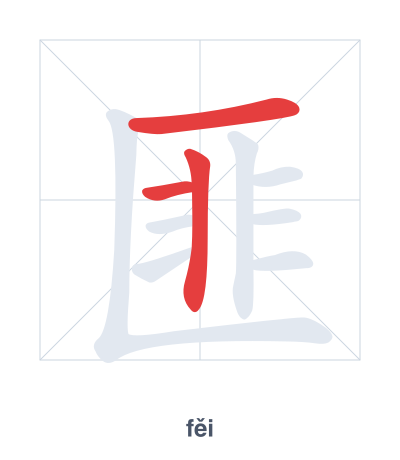
Open Hanzi Writer to see the animated stroke order and practice writing 匪 with real-time feedback.
The character 匪 (fěi) is written with 10 strokes. Follow the standard Chinese stroke order: top to bottom, left to right, outside before inside. The radical 匚 is one of its key components.
Practice the correct stroke order with the Hanzi Writer app to see animated stroke-by-stroke guidance with real-time feedback.
匪 means bandit; robber.
As an HSK Level 7 character, 匪 is an intermediate-level character.
The character 匪 combines the radical 匚 (a box or enclosure) with 非 (meaning 'wrong' or 'not'). Originally it referred to something improper or out of order, later specifically a bandit who does wrong and hides in a box-like lair.
💡 Memory Tip: Imagine a bandit with a crossed-out face (非) lurking inside an open box (匚), ready to rob you.
电影里有很多土匪。
diàn yǐng lǐ yǒu hěn duō tǔ fěi
There are many bandits in the movie.
警察抓住了那个匪徒。
jǐng chá zhuā zhù le nà ge fěi tú
The police caught that gangster.
绑匪要求很多钱。
bǎng fěi yāo qiú hěn duō qián
The kidnappers are demanding a lot of money.
Open Hanzi Writer to see the animated stroke order and practice writing 匪 with real-time feedback.
✨ Animated stroke order · Handwriting recognition · HSK-graded practice · Free to use
The character 匪 combines the radical 匚 (a box or enclosure) with the component 非 (fēi, meaning not or wrong). The enclosure suggests a hiding place, and the wrong element implies outlaws or those who are not proper, together forming the idea of a bandit or robber hiding in a lair.