讷 (nè) means "Slow of speech / Taciturn" in Chinese. It has 6 strokes with the radical 讠.
Rated 2.9/5 in difficulty (moderate).
Appears in 3+ common words including 木讷 (mù nè), 讷讷 (nè nè), 刚毅木讷 (gāng yì mù nè).
Hanzi Writer's stroke validation shows learners typically need 5-8 attempts to write 讷 with correct proportion and order.
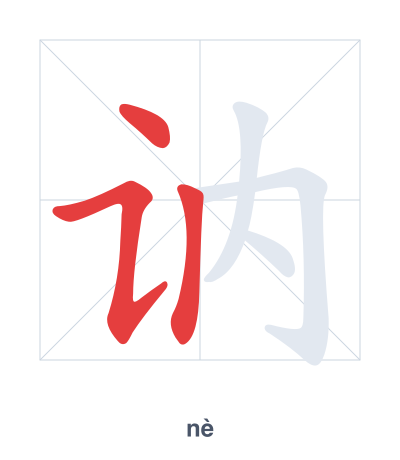
Open Hanzi Writer to see the animated stroke order and practice writing 讷 with real-time feedback.
The character 讷 (nè) is written with 6 strokes. Follow the standard Chinese stroke order: top to bottom, left to right, outside before inside. The radical 讠 is one of its key components.
Practice the correct stroke order with the Hanzi Writer app to see animated stroke-by-stroke guidance with real-time feedback.
讷 means Slow of speech / Taciturn.
讷 combines the speech radical 讠 (言) with 内 (inside). The idea is that words stay 'inside' rather than being spoken out, which reflects a slow or quiet speech.
💡 Memory Tip: Imagine a person with a speech bubble (讠) trapped inside a box (内), unable to get the words out.
他性格木讷,不爱说话。
tā xìng gé mù nè bù ài shuō huà
He is simple and plain-spoken, and doesn't like to talk.
他讷讷地解释了几句。
tā nè nè dì jiě shì le jǐ jù
He explained a few words haltingly.
他是一个刚毅木讷的人。
tā shì yí gè gāng yì mù nè de rén
He is a resolute and reticent person.
Open Hanzi Writer to see the animated stroke order and practice writing 讷 with real-time feedback.
✨ Animated stroke order · Handwriting recognition · HSK-graded practice · Free to use
讷 is composed of the radical 讠 (speech) on the left and 内 (inside) on the right. The speech radical indicates that the character relates to speaking, while 内 suggests that words are kept inside or spoken inwardly. Together, they convey the idea of being slow or hesitant to speak, as if one's speech stays inside.