娜 (nà/nuó) means "graceful" in Chinese. It has 9 strokes with the radical 女.
Rated 4/5 in difficulty (challenging).
Appears in 3+ common words including 安娜 (ān nà), 袅娜 (niǎo nuó), 婀娜 (ē nuó).
Due to its 9 strokes, Hanzi Writer's error detection shows 娜 requires focused practice — most learners need 10+ attempts for consistent accuracy.
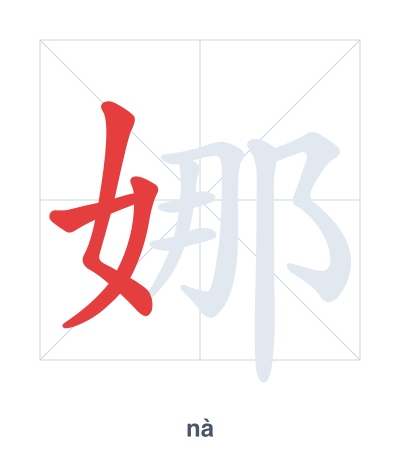
Open Hanzi Writer to see the animated stroke order and practice writing 娜 with real-time feedback.
The character 娜 (nà/nuó) is written with 9 strokes. Follow the standard Chinese stroke order: top to bottom, left to right, outside before inside. The radical 女 is one of its key components.
Practice the correct stroke order with the Hanzi Writer app to see animated stroke-by-stroke guidance with real-time feedback.
娜 means graceful.
This is a polyphonic character with readings: nà, nuó.
娜 (nà) is a phono-semantic compound. The left radical 女 (woman) indicates the character's association with feminine grace, while the right component 那 (nà) provides the pronunciation and may visually suggest a flowing, elegant posture. Together they depict a woman moving with refined, delicate beauty.
💡 Memory Tip: Picture a graceful woman (女) with two elegant earrings (那 looks like two ears) swaying as she dances to music.
安娜是我们班从俄罗斯来的交换生。
ān nà shì wǒ men bān cóng é luó sī lái de jiāo huàn shēng
Anna is an exchange student from Russia in our class.
柳树的枝条在微风中摇曳,姿态非常袅娜。
liǔ shù de zhī tiáo zài wēi fēng zhōng yáo yè zī tài fēi cháng niǎo nuó
The willow branches sway in the breeze, looking very graceful.
舞台上的舞者身姿婀娜,表演非常精彩。
wǔ tái shàng de wǔ zhě shēn zī ē nuó biǎo yǎn fēi cháng jīng cǎi
The dancer on the stage had a graceful figure and gave a wonderful performance.
Open Hanzi Writer to see the animated stroke order and practice writing 娜 with real-time feedback.
✨ Animated stroke order · Handwriting recognition · HSK-graded practice · Free to use
娜 is a left-right character. The left radical 女 (woman) indicates meaning related to feminine grace, while the right part 那 is phonetic and gives the pronunciation nà. Together, they form a character used to describe graceful movements or in transliterated names.