馄 (hún) means "Hun (used in the word 'wonton')" in Chinese. It has 11 strokes with the radical 饣.
Rated 4.2/5 in difficulty (advanced).
Appears in 3+ common words including 馄饨 (hún tún), 馄饨皮 (hún tún pí), 馄饨汤 (hún tún tāng).
Due to its 11 strokes, Hanzi Writer's error detection shows 馄 requires focused practice — most learners need 10+ attempts for consistent accuracy.
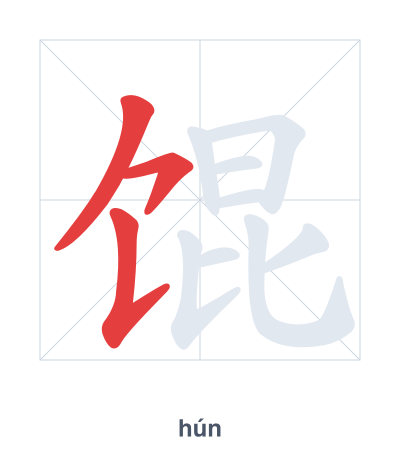
Open Hanzi Writer to see the animated stroke order and practice writing 馄 with real-time feedback.
The character 馄 (hún) is written with 11 strokes. Follow the standard Chinese stroke order: top to bottom, left to right, outside before inside. The radical 饣 is one of its key components.
Practice the correct stroke order with the Hanzi Writer app to see animated stroke-by-stroke guidance with real-time feedback.
馄 means Hun (used in the word 'wonton').
馄 is a phono-semantic compound: the left radical 饣 (food) indicates it is a type of food, and the right component 昆 provides the pronunciation. It is used in the word 馄饨 (húntun), meaning wonton, a stuffed dumpling served in soup.
💡 Memory Tip: Picture the food radical 饣 as a steaming bowl of soup, and the right side 昆 as a plump wonton with folded edges floating inside.
这碗馄饨很鲜。
zhè wǎn hún tún hěn xiān
This bowl of wontons is very savory.
我们要买馄饨皮。
wǒ men yào mǎi hún tún pí
We want to buy wonton wrappers.
馄饨汤很好喝。
hún tún tāng hěn hǎo hē
The wonton soup is delicious.
Open Hanzi Writer to see the animated stroke order and practice writing 馄 with real-time feedback.
✨ Animated stroke order · Handwriting recognition · HSK-graded practice · Free to use
馄 is made of the radical 饣 (food) on the left and the phonetic component 困 (kùn) on the right. The radical 饣 shows its meaning relates to food, while the right side provides the sound. Together they form part of the word 馄饨 (wonton), a type of food.