缪 (miù/móu) means "Error; mistake; (also a surname)" in Chinese. It has 14 strokes with the radical 纟.
Rated 4.2/5 in difficulty (advanced).
Appears in 3+ common words including 荒谬 (huāng miù), 绸缪 (chóu móu), 姓缪 (xìng móu).
Due to its 14 strokes, Hanzi Writer's error detection shows 缪 requires focused practice — most learners need 10+ attempts for consistent accuracy.
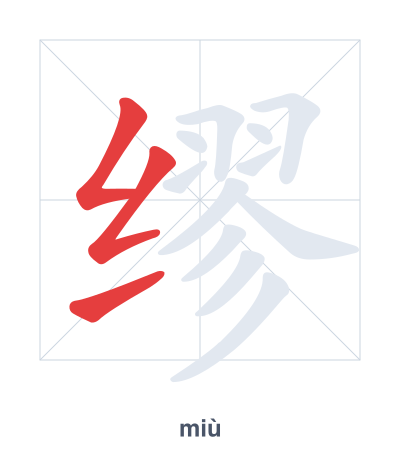
Open Hanzi Writer to see the animated stroke order and practice writing 缪 with real-time feedback.
The character 缪 (miù/móu) is written with 14 strokes. Follow the standard Chinese stroke order: top to bottom, left to right, outside before inside. The radical 纟 is one of its key components.
Practice the correct stroke order with the Hanzi Writer app to see animated stroke-by-stroke guidance with real-time feedback.
缪 means Error; mistake; (also a surname).
This is a polyphonic character with readings: miù, móu.
缪 combines the silk radical 纟 (thread) with 翏 (liù, a phonetic component suggesting disorder). Tangled silk threads in weaving create errors, linking to the meaning of mistake or error.
💡 Memory Tip: Imagine a silk thread (纟) getting tangled with feathers (羽) and stripes (彡), causing a complete mess—that's a big mistake (缪).
这种毫无科学依据的说法简直是荒谬透顶。
zhè zhǒng háo wú kē xué yī jù de shuō fǎ jiǎn zhí shì huāng miù tòu dǐng
This claim, which lacks any scientific basis, is simply preposterous.
面对未知的风险,我们应当未雨绸缪。
miàn duì wèi zhī de fēng xiǎn wǒ men yīng dāng wèi yǔ chóu móu
Facing unknown risks, we should prepare for a rainy day.
缪先生是我们这次画展的策展人。
móu xiān shēng shì wǒ men zhè cì huà zhǎn de cè zhǎn rén
Mr. Miao is the curator of our art exhibition.
Open Hanzi Writer to see the animated stroke order and practice writing 缪 with real-time feedback.
✨ Animated stroke order · Handwriting recognition · HSK-graded practice · Free to use
The left side 纟 (silk radical) suggests the character relates to threads or textiles. The right side 翏 (liù, meaning tall or lofty, but also a phonetic component) gives the pronunciation miù. Together, the silk radical plus a sound component indicate a word originally about tangled silk or errors in weaving, hence the meanings "error" or "mistake."