瞑 (míng) means "To close one's eyes" in Chinese. It has 15 strokes with the radical 目.
Rated 4.2/5 in difficulty (advanced).
Appears in 3+ common words including 瞑目 (míng mù), 瞑想 (míng xiǎng), 瞑色 (míng sè).
Due to its 15 strokes, Hanzi Writer's error detection shows 瞑 requires focused practice — most learners need 10+ attempts for consistent accuracy.
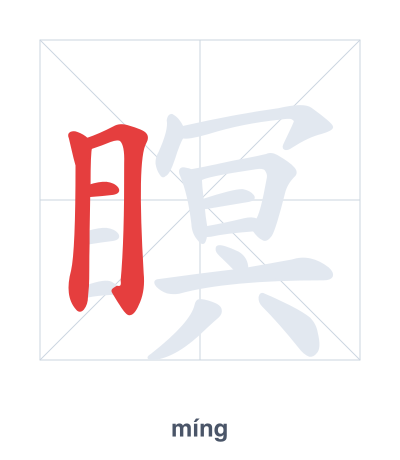
Open Hanzi Writer to see the animated stroke order and practice writing 瞑 with real-time feedback.
The character 瞑 (míng) is written with 15 strokes. Follow the standard Chinese stroke order: top to bottom, left to right, outside before inside. The radical 目 is one of its key components.
Practice the correct stroke order with the Hanzi Writer app to see animated stroke-by-stroke guidance with real-time feedback.
瞑 means To close one's eyes.
The character 瞑 combines the radical 目 (eye) on the left, indicating its connection to vision, with the phonetic component 冥 on the right, which originally meant 'dark' or 'obscure.' Together, they suggest the act of closing one's eyes, bringing darkness to the visual field.
💡 Memory Tip: Imagine the sun setting (冥) and you close your eyes (目) to sleep, letting darkness cover your sight.
他闭目瞑思。
tā bì mù míng sī
He closed his eyes and meditated.
我每天都瞑想。
wǒ měi tiān dōu míng xiǎng
I meditate every day.
瞑色已经降临。
míng sè yǐ jīng jiàng lín
Twilight has already fallen.
Open Hanzi Writer to see the animated stroke order and practice writing 瞑 with real-time feedback.
✨ Animated stroke order · Handwriting recognition · HSK-graded practice · Free to use
The left part 目 is the eye radical, directly linking the character to eyes. The right part 冥 provides the sound (míng) and adds the idea of darkness or obscurity. So, 瞑 literally describes the action of making your eyes dark by closing them, which is exactly what it means.