闽 (mǐn) means "Short name for Fujian province" in Chinese. It has 9 strokes with the radical 门.
Rated 4/5 in difficulty (challenging).
Appears in 3+ common words including 闽菜 (mǐn cài), 闽南语 (mǐn nán yǔ), 闽剧 (mǐn jù).
Due to its 9 strokes, Hanzi Writer's error detection shows 闽 requires focused practice — most learners need 10+ attempts for consistent accuracy.
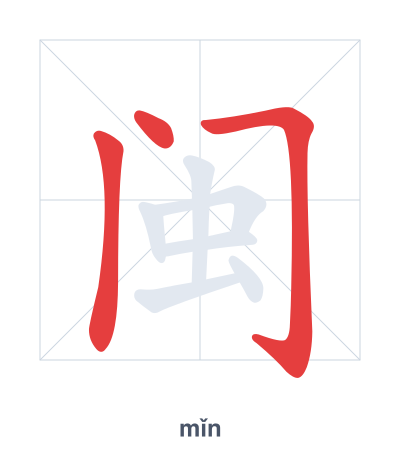
Open Hanzi Writer to see the animated stroke order and practice writing 闽 with real-time feedback.
The character 闽 (mǐn) is written with 9 strokes. Follow the standard Chinese stroke order: top to bottom, left to right, outside before inside. The radical 门 is one of its key components.
Practice the correct stroke order with the Hanzi Writer app to see animated stroke-by-stroke guidance with real-time feedback.
闽 means Short name for Fujian province.
闽 combines the radical 门 (door/gate) with 虫 (snake/insect). Historically, the character referred to the Min people of Fujian, who revered snakes as totems; thus the image suggests a snake entering a door, symbolizing the region's association with snakes.
💡 Memory Tip: Imagine a snake (虫) slithering through a gate (门) into the province of Fujian.
我很喜欢吃闽菜。
wǒ hěn xǐ huān chī mǐn cài
I really like eating Fujian cuisine.
他会说闽南语。
tā huì shuō mǐn nán yǔ
He can speak Southern Min.
我们去看闽剧吧。
wǒ men qù kàn mǐn jù ba
Let's go watch Min Opera.
Open Hanzi Writer to see the animated stroke order and practice writing 闽 with real-time feedback.
✨ Animated stroke order · Handwriting recognition · HSK-graded practice · Free to use
The character 闽 is made of the radical ‘门’ (door) on the outside and the component ‘虫’ (insect; worm) inside. Historically, Fujian was known for its mountainous, humid climate where snakes (often represented by ‘虫’ in ancient scripts) were common, so the character combines ‘door’ with ‘insect’ to represent the region.