邈 (miǎo) means "remote / distant" in Chinese. It has 17 strokes with the radical 辶.
Rated 4.2/5 in difficulty (advanced).
Appears in 3+ common words including 遥邈 (yáo miǎo), 邈远 (miǎo yuǎn), 邈若两人 (miǎo ruò liǎng rén).
Due to its 17 strokes, Hanzi Writer's error detection shows 邈 requires focused practice — most learners need 10+ attempts for consistent accuracy.
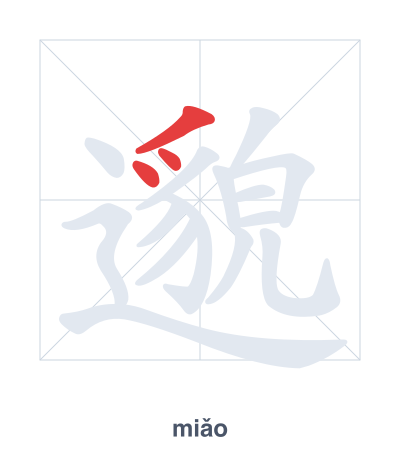
Open Hanzi Writer to see the animated stroke order and practice writing 邈 with real-time feedback.
The character 邈 (miǎo) is written with 17 strokes. Follow the standard Chinese stroke order: top to bottom, left to right, outside before inside. The radical 辶 is one of its key components.
Practice the correct stroke order with the Hanzi Writer app to see animated stroke-by-stroke guidance with real-time feedback.
邈 means remote / distant.
邈 is a phono-semantic compound: the radical 辶 (walk) suggests movement or distance, while the component 貌 (mào, appearance) provides a phonetic hint. Together, they evoke the idea of traveling so far that even the appearance of a place becomes indistinct and remote.
💡 Memory Tip: Imagine walking (辶) until someone's face or appearance (貌) becomes a tiny, distant blur.
那个山村很遥邈。
nà ge shān cūn hěn yáo miǎo
That mountain village is very remote.
他的理想很邈远。
tā de lǐ xiǎng hěn miǎo yuǎn
His ideals are very remote.
他现在和以前邈若两人。
tā xiàn zài hé yǐ qián miǎo ruò liǎng rén
He is a completely different person now compared to before.
Open Hanzi Writer to see the animated stroke order and practice writing 邈 with real-time feedback.
✨ Animated stroke order · Handwriting recognition · HSK-graded practice · Free to use
邈 is composed of the radical 辶 (walking/road) on the left and the phonetic component 貌 (mào, appearance) on the right. The radical suggests distance traveled, while 貌 adds sound and the idea of something far away in appearance. Together, they convey the sense of being visually or physically distant.