糜 (mí) means "Gruel" in Chinese. It has 17 strokes with the radical 米.
Rated 4.2/5 in difficulty (advanced).
Appears in 3+ common words including 肉糜 (ròu mí), 糜烂 (mí làn), 粥糜 (zhōu mí).
Due to its 17 strokes, Hanzi Writer's error detection shows 糜 requires focused practice — most learners need 10+ attempts for consistent accuracy.
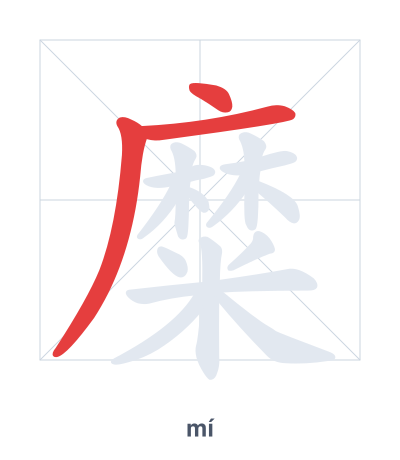
Open Hanzi Writer to see the animated stroke order and practice writing 糜 with real-time feedback.
The character 糜 (mí) is written with 17 strokes. Follow the standard Chinese stroke order: top to bottom, left to right, outside before inside. The radical 米 is one of its key components.
Practice the correct stroke order with the Hanzi Writer app to see animated stroke-by-stroke guidance with real-time feedback.
糜 means Gruel.
糜 is a phono-semantic compound where 米 (rice) indicates the food category, and 麻 (hemp) provides the sound mí. The character originally described a soft porridge or gruel made from rice, reflecting the rice radical's meaning.
💡 Memory Tip: Imagine a pile of hemp (麻) stalks being crushed into rice (米) to make a sticky, mushy gruel.
把肉剁成肉糜。
bǎ ròu duò chéng ròu mí
Mince the meat into a paste.
伤口已经糜烂。
shāng kǒu yǐ jīng mí làn
The wound has already become ulcerated.
锅里煮着粥糜。
guō lǐ zhǔ zhe zhōu mí
Congee is cooking in the pot.
Open Hanzi Writer to see the animated stroke order and practice writing 糜 with real-time feedback.
✨ Animated stroke order · Handwriting recognition · HSK-graded practice · Free to use
糜 is a top-bottom character: the top part is 麻 (hemp) and the bottom is 米 (rice). The bottom radical 米 directly relates to the meaning of gruel, which is a food made from rice. The top part 麻 may have originally provided a phonetic clue, though its pronunciation is slightly different.