Hanzi Writer

How to Write 昴 (mǎo) — Meaning “Pleiades (star cluster)”

mǎo 9 strokes Radical: 日

昴 (mǎo) means "Pleiades (star cluster)" in Chinese. It has 9 strokes with the radical 日.

Rated 4/5 in difficulty (challenging).

Appears in 3+ common words including 昴宿 (mǎo sù), 昴星 (mǎo xīng), 昴日 (mǎo rì).

Due to its 9 strokes, Hanzi Writer's error detection shows 昴 requires focused practice — most learners need 10+ attempts for consistent accuracy.
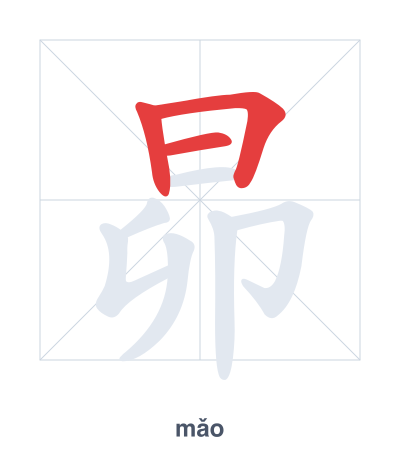
Stroke order practice for 昴 - mǎo

Practice Writing 昴 (mǎo)

Open Hanzi Writer to see the animated stroke order and practice writing 昴 with real-time feedback.

The character (mǎo) is written with 9 strokes. Follow the standard Chinese stroke order: top to bottom, left to right, outside before inside. The radical is one of its key components.

Practice the correct stroke order with the Hanzi Writer app to see animated stroke-by-stroke guidance with real-time feedback.

means Pleiades (star cluster).

Character
Pinyinmǎo (mao)
MeaningPleiades (star cluster)
Strokes9
Radical
Difficulty4/5

昴 combines the radical 日 (a star or celestial body) with the phonetic component 卯 (mǎo, the fourth Earthly Branch associated with the Rabbit). In ancient Chinese astronomy, 昴 denotes the Pleiades star cluster, one of the 28 lunar mansions marking the moon's path.

💡 Memory Tip: Picture the Pleiades as a sparkling cluster (日) above a rabbit (卯) leaping through the night sky.

宿 mǎo sù
Pleiades (one of the 28 mansions)
mǎo xīng
Pleiades stars
mǎo rì
The sun in the Pleiades

昴宿是星官名。

mǎo sù shì xīng guān míng

Maoxiu is the name of a star constellation.

昴星在夜空闪烁。

mǎo xīng zài yè kōng shǎn shuò

The Pleiades stars twinkle in the night sky.

昴日星官很有名。

mǎo rì xīng guān hěn yǒu míng

The Pleiades Star Official is very famous.

Character Pinyin Strokes Radical
(current) mǎo 9
gàn 7
hàn 7
tái 7
Stroke order practice for 昴 - mǎo

Practice Writing 昴 (mǎo)

Open Hanzi Writer to see the animated stroke order and practice writing 昴 with real-time feedback.

✨ Animated stroke order · Handwriting recognition · HSK-graded practice · Free to use

Frequently Asked Questions about 昴

昴 is composed of the radical 日 (sun) on top and 卯 (mǎo, a phonetic component) below. The 日 suggests something related to celestial bodies, while 卯 provides the pronunciation. Together, they form the name of the Pleiades star cluster, a group of stars visible in the night sky.

Characters with Radical 日

Other 9-Stroke Characters