芒 (máng) means "Miscanthus / Awning of a plant" in Chinese. It has 6 strokes with the radical 艹, and is HSK Level 7.
Rated 3.2/5 in difficulty (challenging).
Harder than 11% of HSK Level 7 characters.
Appears in 3+ common words including 芒果 (máng guǒ), 光芒 (guāng máng), 芒种 (máng zhòng).
Due to its 6 strokes, Hanzi Writer's error detection shows 芒 requires focused practice — most learners need 10+ attempts for consistent accuracy.
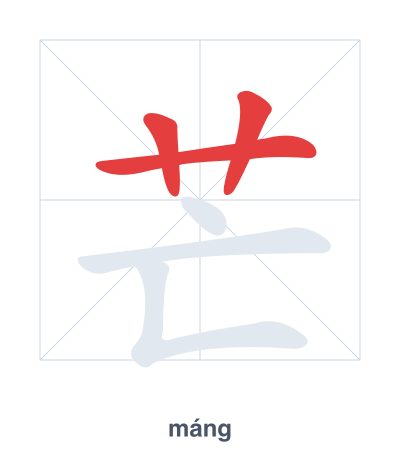
Open Hanzi Writer to see the animated stroke order and practice writing 芒 with real-time feedback.
The character 芒 (máng) is written with 6 strokes. Follow the standard Chinese stroke order: top to bottom, left to right, outside before inside. The radical 艹 is one of its key components.
Practice the correct stroke order with the Hanzi Writer app to see animated stroke-by-stroke guidance with real-time feedback.
芒 means Miscanthus / Awning of a plant.
As an HSK Level 7 character, 芒 is an intermediate-level character.
芒 is a compound character combining the radical 艹 (grass) and the phonetic component 亡 (wáng, meaning 'to die' or 'to flee'). The grass radical indicates it's a plant, specifically Miscanthus, a tall grass with sharp, awn-like tips that can form a protective covering.
💡 Memory Tip: Imagine a grass plant (艹) whose top has died (亡) and turned into a sharp, prickly awning—so sharp it makes you say 'mang!'
我爱吃芒果。
wǒ ài chī máng guǒ
I love eating mangoes.
太阳有光芒。
tài yáng yǒu guāng máng
The sun has rays of light.
今天是芒种。
jīn tiān shì máng zhòng
Today is Grain in Beard (Mangzhong).
Open Hanzi Writer to see the animated stroke order and practice writing 芒 with real-time feedback.
✨ Animated stroke order · Handwriting recognition · HSK-graded practice · Free to use
芒 is composed of the grass radical 艹 on top and 亡 (wáng) below. The grass radical indicates that this character relates to plants, and 亡 gives the sound máng. Together they form a character for a type of grass with sharp tips.