镘 (màn) means "trowel" in Chinese. It has 16 strokes with the radical 钅.
Rated 4.2/5 in difficulty (advanced).
Appears in 3+ common words including 镘刀 (màn dāo), 泥镘 (ní màn), 抹镘 (mǒ màn).
Due to its 16 strokes, Hanzi Writer's error detection shows 镘 requires focused practice — most learners need 10+ attempts for consistent accuracy.
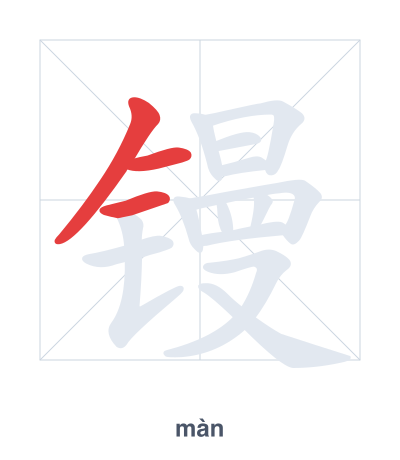
Open Hanzi Writer to see the animated stroke order and practice writing 镘 with real-time feedback.
The character 镘 (màn) is written with 16 strokes. Follow the standard Chinese stroke order: top to bottom, left to right, outside before inside. The radical 钅 is one of its key components.
Practice the correct stroke order with the Hanzi Writer app to see animated stroke-by-stroke guidance with real-time feedback.
镘 means trowel.
镘 is a phono-semantic compound with 钅 (metal, indicating the tool's material) and 曼 (màn, providing the pronunciation). The character was created to represent a metal smoothing tool used in masonry and plastering, known as a trowel.
💡 Memory Tip: Picture a metal tool (钅) with a long, graceful handle (曼) that you use to spread mortar like a painter's brush.
工人拿着一把镘刀。
gōng rén ná zhe yī bǎ màn dāo
The worker is holding a trowel.
他用泥镘抹平墙面。
tā yòng ní màn mǒ píng qiáng miàn
He used a trowel to smooth the wall.
这个抹镘很好用。
zhè ge mǒ màn hěn hǎo yòng
This trowel is very easy to use.
Open Hanzi Writer to see the animated stroke order and practice writing 镘 with real-time feedback.
✨ Animated stroke order · Handwriting recognition · HSK-graded practice · Free to use
镘 is a left-right character. The left radical 钅 (jīn) indicates metal, and the right part 曼 (màn) provides the sound and carries a hint of the action of spreading or smoothing. Together, they form a metal tool used for spreading and smoothing plaster or cement.