闾 (lǘ) means "Gate of a lane; village" in Chinese. It has 9 strokes with the radical 门.
Rated 4/5 in difficulty (challenging).
Appears in 3+ common words including 闾里 (lǘ lǐ), 闾巷 (lǘ xiàng), 门闾 (mén lǘ).
Due to its 9 strokes, Hanzi Writer's error detection shows 闾 requires focused practice — most learners need 10+ attempts for consistent accuracy.
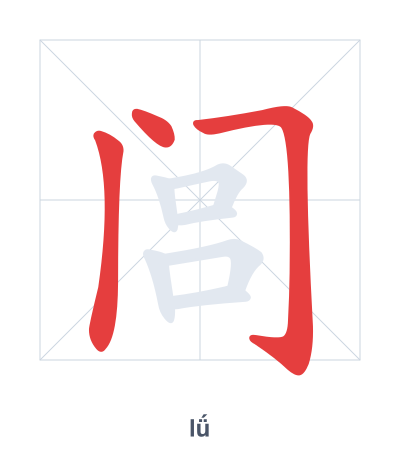
Open Hanzi Writer to see the animated stroke order and practice writing 闾 with real-time feedback.
The character 闾 (lǘ) is written with 9 strokes. Follow the standard Chinese stroke order: top to bottom, left to right, outside before inside. The radical 门 is one of its key components.
Practice the correct stroke order with the Hanzi Writer app to see animated stroke-by-stroke guidance with real-time feedback.
闾 means Gate of a lane; village.
闾 is a compound character. The radical 门 (gate) indicates the meaning of an entrance, while 吕, originally picturing two vertebrae aligned, here suggests the narrow, orderly lanes of a village or a row of houses. Together, they depict the gate of a rural alley or hamlet.
💡 Memory Tip: Picture a gate (门) with two sideways houses (吕) inside, marking the entrance to a cozy village lane.
他在闾里很有名。
tā zài lǘ lǐ hěn yǒu míng
He is very famous in the neighborhood.
走在古老的闾巷中。
zǒu zài gǔ lǎo de lǘ xiàng zhōng
Walking in the ancient alleys.
这里的门闾很漂亮。
zhè lǐ de mén lǘ hěn piào liàng
The gates and entrances here are very beautiful.
Open Hanzi Writer to see the animated stroke order and practice writing 闾 with real-time feedback.
✨ Animated stroke order · Handwriting recognition · HSK-graded practice · Free to use
闾 is a compound character with the radical 门 (gate) on the outside and 吕 (lǚ) on the inside. The 门 radical directly indicates that the character refers to a gate or entrance, while 吕 provides the pronunciation. Together, they form the meaning "gate of a lane" or a village entrance.