倮 (luǒ) means "naked; bare" in Chinese. It has 10 strokes with the radical 亻.
Rated 3.9/5 in difficulty (challenging).
Appears in 3+ common words including 倮虫 (luǒ chóng), 倮体 (luǒ tǐ), 赤倮倮 (chì luǒ luǒ).
Due to its 10 strokes, Hanzi Writer's error detection shows 倮 requires focused practice — most learners need 10+ attempts for consistent accuracy.
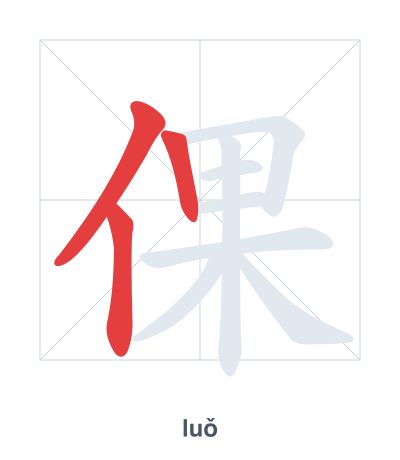
Open Hanzi Writer to see the animated stroke order and practice writing 倮 with real-time feedback.
The character 倮 (luǒ) is written with 10 strokes. Follow the standard Chinese stroke order: top to bottom, left to right, outside before inside. The radical 亻 is one of its key components.
Practice the correct stroke order with the Hanzi Writer app to see animated stroke-by-stroke guidance with real-time feedback.
倮 means naked; bare.
倮 combines the person radical 亻 with 果 (fruit), suggesting a person stripped bare like a fruit without its skin. In ancient usage, it was a variant of 裸, emphasizing the state of being unclothed.
💡 Memory Tip: Picture a person (亻) who has peeled off all their clothes like peeling a fruit (果), leaving them completely naked.
什么是倮虫?
shén me shì luǒ chóng
What are 'naked insects' (ancient term for mammals)?
这是一个倮体雕塑。
zhè shì yí gè luǒ tǐ diāo sù
This is a nude sculpture.
事实是赤倮倮的。
shì shí shì chì luǒ luǒ de
The facts are stark and naked.
Open Hanzi Writer to see the animated stroke order and practice writing 倮 with real-time feedback.
✨ Animated stroke order · Handwriting recognition · HSK-graded practice · Free to use
倮 is made of the radical 亻 (person) on the left and 果 (fruit) on the right. The combination suggests a person who is bare, like a fruit without its skin. This directly connects to the meaning 'naked' or 'bare'.